
|
Getting your Trinity Audio player ready...
|
Across India and the global Hindu diaspora, Navratri is among the most jubilant, most devotionally intense, and most spiritually layered festivals of the year. Nine nights — nava ratri in Sanskrit — dedicated entirely to the worship of Shakti: the divine feminine energy that underlies all of creation.
But Navratri is far more than nine days of fasting, garba dancing, and decorated pandals. At its luminous core lies a profound spiritual curriculum: the systematic worship of nine distinct manifestations of the Goddess, collectively known as Navdurga — the nine Durgas. Each form carries a unique set of attributes, a specific mantra, an associated colour, a vehicle (vahana), and blessings she bestows on sincere devotees.
This guide draws on the Devi Mahatmya (also called the Durga Saptashati), the Shiva Purana, the Skanda Purana, and the living testimony of generations of devotees. Whether you are approaching Navratri for the first time or deepening a practice of decades, we hope this article illuminates each goddess with the care and precision she deserves.
The Nine Forms of Goddess Durga
| Day | Devi Name | Symbolism | Worship Significance |
|---|---|---|---|
| Day 1 | Shailaputri | Daughter of the Himalayas | Represents strength and devotion; devotees begin Navratri with her blessings. |
| Day 2 | Brahmacharini | Goddess of penance | Symbolizes discipline, austerity, and wisdom; worshippers seek peace and prosperity. |
| Day 3 | Chandraghanta | Goddess with a crescent moon | Embodies courage and serenity; protects devotees from evil forces. |
| Day 4 | Kushmanda | Creator of the universe | Associated with energy and vitality; believed to bless devotees with health and wealth. |
| Day 5 | Skandamata | Mother of Kartikeya | Symbolizes maternal love and protection; grants wisdom and prosperity. |
| Day 6 | Katyayani | Warrior goddess | Known for courage and righteousness; worshipped for removing obstacles in marriage. |
| Day 7 | Kalaratri | Fierce form of Durga | Represents destruction of evil; devotees seek protection and fearlessness. |
| Day 8 | Mahagauri | Goddess of purity | Symbolizes peace, compassion, and forgiveness; worshipped for prosperity and relief from suffering. |
| Day 9 | Siddhidatri | Goddess of supernatural powers | Grants spiritual knowledge and success; worshippers seek fulfillment of desires. |
The Theology of Navdurga: Why Nine Forms?
In the Shakta tradition of Hinduism — which reveres the Divine primarily as the feminine principle — the Goddess is simultaneously one and many. She is Adi Shakti, the primordial energy; she is also Durga, Kali, Lakshmi, Saraswati, and infinite other forms, each expressing a different facet of her nature. The concept of Navdurga is both theological and devotional: by encountering the Goddess through nine distinct “lenses” across nine consecutive days, the devotee is led through a progressive inward journey from the material world toward spiritual liberation (moksha).
Scholars of Hindu philosophy note that the nine forms correspond to three triads. The first three goddesses — Shailputri, Brahmacharini, Chandraghanta — are associated with Tamas guna: grounding, release of past conditioning, and overcoming inertia. The next three — Kushmanda, Skandamata, Katyayani — correspond to Rajas guna: dynamic energy, creativity, and courageous action. The final three — Kaalratri, Mahagauri, Siddhidatri — represent Sattva guna: pure wisdom, radiance, and perfected spiritual attainment.
1. Maa Shailaputri (Day 1)
| Aspect | Details |
|---|---|
| Day | First (Pratipada) |
| Colour | Yellow / Orange |
| Vehicle | Nandi (Bull) |
| Symbols | Trishul & Lotus |
| Planet | Moon (Chandra) |
| Blessing | Stability & Grounding |
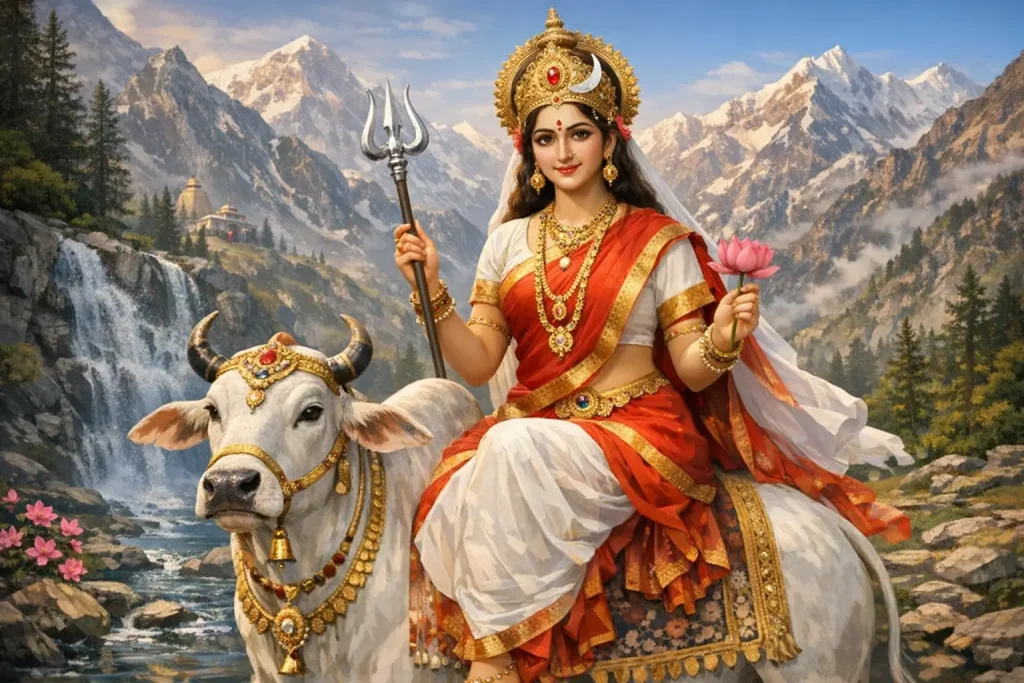
The first form of Navdurga, Maa Shailputri, is the daughter of Himavat — the king of the Himalayas. Her name joins shaila (mountain) with putri (daughter), and in this etymology lies her essential teaching: she is the foundational energy, as unshakeable as the mountains themselves. In her previous life, she was Sati — the beloved consort of Lord Shiva — who immolated herself when her father Daksha dishonoured her husband. Reborn as Parvati to Himavat, she would eventually win Shiva back through incomparable devotion and austerity.
She rides the bull Nandi — Shiva’s own vehicle — carrying a trident (trishul) in her right hand and a lotus (kamal) in her left. The trishul represents the capacity to destroy the three types of suffering (physical, mental, and spiritual); the lotus symbolises pure awareness blossoming from earthly soil. She governs the Moon in Vedic astrology, and her worship on the first day of Navratri is said to rectify Chandra dosha — imbalances associated with the lunar influence in one’s birth chart.
On a deeper symbolic level, Shailputri represents the root of all spiritual practice: groundedness, steadiness, and the courage to begin. She is the foundation upon which the entire edifice of the remaining eight goddesses is built. Devotees who worship her sincerely are said to receive stability in health, relationships, and spiritual commitment. She is the reminder that every great inner journey begins with the feet firmly planted on the earth.
Primary Mantra: Vande Vaanchita Laabhaya, Chandrardhakritashekharam | Vrisharudham Shoolahastam Shailputrim Yashasvinim ||
वन्दे वाञ्चित लाभाय, चन्द्रार्धकृतशेखरम् | वृषारूढं शूलहस्तं शैलपुत्रीं यशस्विनीम् ||
Offering & practice: Pure cow’s ghee is the traditional offering to Maa Shailputri — anointed in a lamp at dawn. Yellow or orange clothing is worn to invoke her radiant presence. Her worship is said to bestow a strong and healthy physical constitution and remove sorrows accumulated across lifetimes.
2. Maa Brahmacharini (Day 2)
| Aspect | Details |
|---|---|
| Day | Second (Dwitiya) |
| Colour | Green |
| Vehicle | Walks barefoot |
| Symbols | Japa Mala & Kamandalu |
| Planet | Mars (Mangal) |
| Blessing | Discipline & Devotion |
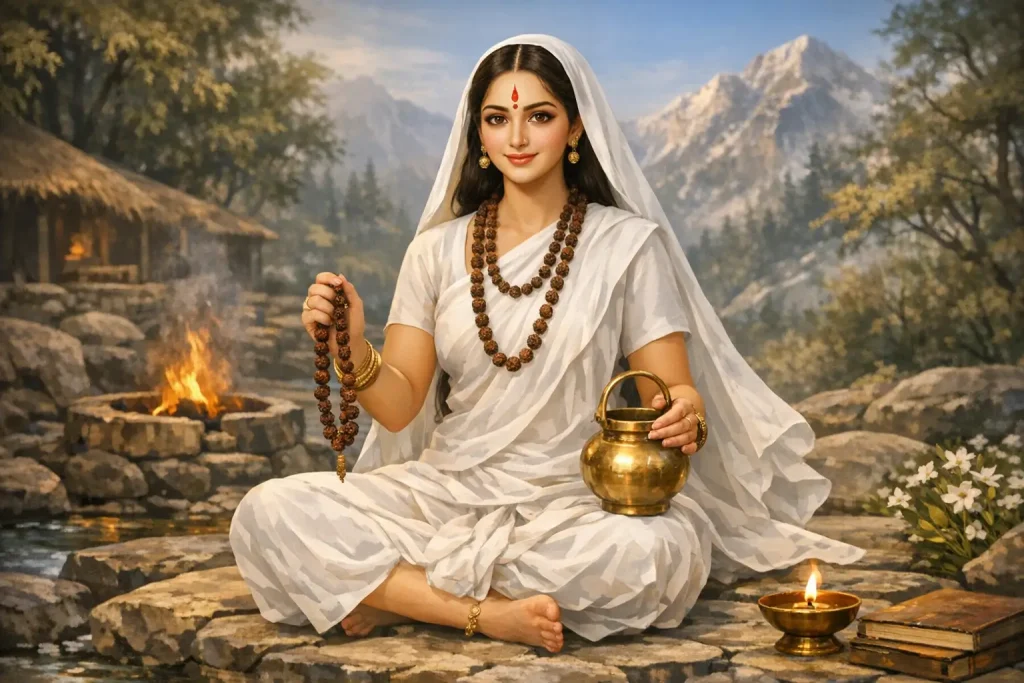
Maa Brahmacharini embodies the supreme tapas — spiritual austerity — that Parvati performed to win Lord Shiva as her husband. The name joins Brahma (ultimate reality and spiritual practice) with charini (one who moves in or practises). She is depicted as a young ascetic walking barefoot, clothed in white, carrying a rosary (japa mala) in her right hand and a water pot (kamandalu) in her left — the iconic implements of the renunciate.
Her story is extraordinary. Advised by the divine sage Narada that only Lord Shiva could be her husband — and that winning him would require extraordinary sacrifice — Parvati undertook thousands of years of increasingly severe austerities. She survived on leaves, then on water alone, then on nothing at all. This extreme stage earned her the name Aparna — “she who took no leaves.” She stood in freezing rivers, endured searing heat, and maintained absolute stillness of mind throughout. When Shiva appeared to test her by speaking ill of himself, she refused to waver — her love rooted not in his appearance but in her own deepening recognition of truth.
Maa Brahmacharini bestows the gifts of patience, discipline, and unwavering commitment on her devotees. She is the patron of students, meditators, and those undergoing difficult life transitions who require the inner fortitude to persist. Her message is simple and revolutionary: perseverance without expectation is the highest form of devotion.
Primary Mantra: Ya Devi Sarvabhooteshu Brahmacharini Roopena Samsthita | Namastasyai Namastasyai Namastasyai Namo Namah ||
या देवी सर्वभूतेषु ब्रह्मचारिणी रूपेण संस्थिता | नमस्तस्यै नमस्तस्यै नमस्तस्यै नमो नमः ||
Offering & practice: Sugar and panchameva (a mix of five dry fruits) are offered on this day. Green — the colour of growth, perseverance, and new beginnings — is the devotional colour of Maa Brahmacharini’s day.
3. Maa Chandraghanta (Day 3)
| Aspect | Details |
|---|---|
| Day | Third (Tritiya) |
| Colour | Grey / Silver |
| Vehicle | Tiger |
| Symbols | Ten arms, weapons & lotus |
| Planet | Venus (Shukra) |
| Blessing | Courage & Grace |
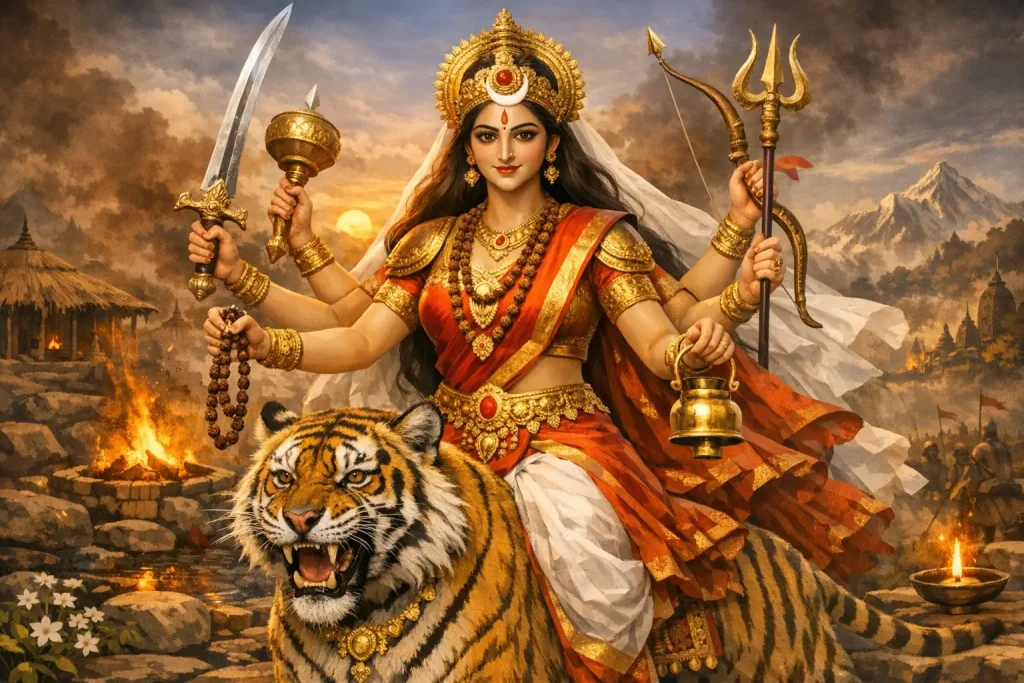
Maa Chandraghanta is the warrior form of the Goddess, breathtaking in her martial beauty. She wears a half-moon (chandra) shaped like a bell (ghanta) on her forehead — hence her name. Riding a tiger with ten arms that carry an array of weapons — trident, mace, sword, and bow — she simultaneously raises one hand in the gesture of blessing (abhaya mudra) and holds a lotus in another. Her complexion shines golden, like the first light of dawn.
This form of the Goddess represents the moment Parvati transformed herself for her wedding to Shiva — adorning herself with the crescent moon and assuming her warrior identity to impress his fearsome entourage. The roar of her lion vehicle is said to make demons tremble and fill devotees with a profound, inexplicable courage. According to the Shiva Purana, the bell on her forehead repels negative energies and fills the surrounding space with positive, protective vibration.
Maa Chandraghanta is especially significant for those who struggle with self-doubt, fear, or anxiety. Her message is the simultaneous coexistence of grace and power — she is ferociously protective yet supremely serene. Her worship harmonises relationships, cultivates equanimity, and grants the courage to face difficult truths without flinching.
Primary Mantra: Pindajapravar Arudha Chandakopastrakairyuta | Prasadam Tanute Mahyam Chandraghanteti Vishrutaa ||
पिण्डजप्रवर अरुधा चण्डकोपास्त्रकैर्युता | प्रसादं तनुते मह्यं चन्द्रघण्टेति विश्रुता ||
Offering & practice: Milk and milk-based sweets are offered to Chandraghanta. Grey or silver — like storm clouds before rain, signifying both power and transformative change — is worn on this day.
4. Maa Kushmanda (Day 4)
| Aspect | Details |
|---|---|
| Day | Fourth (Chaturthi) |
| Colour | Orange / Golden |
| Vehicle | Lion |
| Symbols | Eight arms, weapons & rosary |
| Planet | Sun (Surya) |
| Blessing | Energy, Vitality & Abundance |
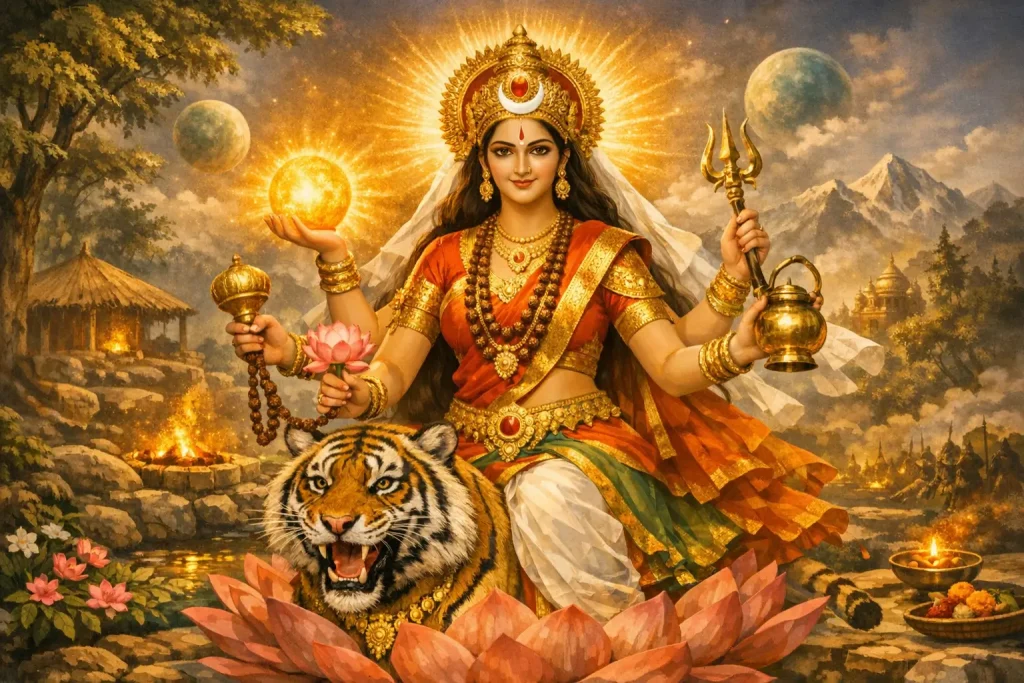
Maa Kushmanda is arguably the most cosmologically significant of all the Navdurga forms, for she is believed to be the original source of the universe itself. Her name is decoded as: ku (little) + ushma (warmth/energy) + anda (cosmic egg). She is the primordial singularity — the little warm cosmic egg from which all of creation expanded.
According to the Markandeya Purana, when the universe existed in a state of complete darkness and void, Maa Kushmanda smiled — and from that divine smile, creation itself began. The sun, the galaxies, the dimensions of time and space — all emerged from the radiance of her luminous laughter. She resides within the solar system’s core, and it is by her energy that the sun itself burns and sustains all life. This is one of the most expansive cosmological claims in all of world religion — that the universe is, at its origin, a smile.
She possesses eight arms (ashtabhuja), carrying a water pot, bow, arrow, lotus, nectar jar (amrit kalash), discus (chakra), and a rosary, while one hand is always raised in blessing. The association with Surya makes the fourth day of Navratri among the most auspicious for offerings, as her worship is said to dissolve chronic illness and bestow long life and vitality.
Primary Mantra: Suraa Sampoornam Kalasham Rudhiraaplutameva Cha | Dadhana Hastpadmaabhyaam Kushmanda Shubhadastu Me ||
सुरा सम्पूर्णं कलशं रुधिराप्लुतमेव च | दधाना हस्तपद्माभ्यं कूष्माण्डा शुभदास्तु मे ||
Offering & practice: Malpua (a sweet pancake) is the traditional offering. Orange — vibrant, solar, and life-giving — is worn on this day, resonating with her association with the sun’s creative and sustaining fire.
5. Maa Skandamata (Day 5)
| Aspect | Details |
|---|---|
| Day | Fifth (Panchami) |
| Colour | White |
| Vehicle | Lion |
| Symbols | Child Kartikeya on her lap |
| Planet | Mercury (Budh) |
| Blessing | Maternal Love & Protection |
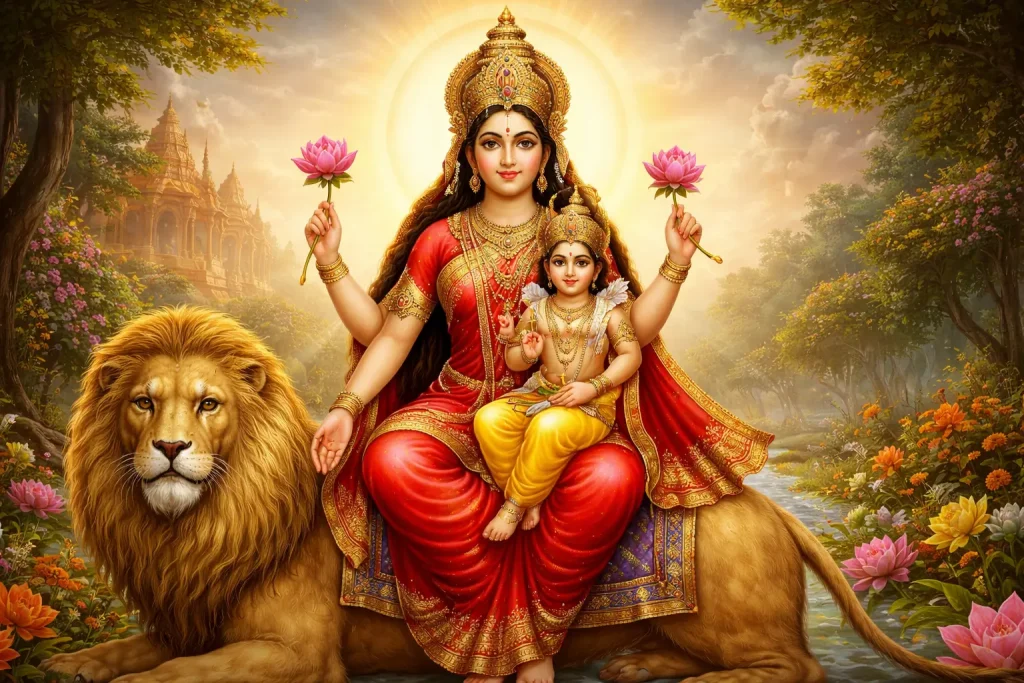
The fifth form of Navdurga is Maa Skandamata — the mother of Lord Skanda, also known as Kartikeya, commander-in-chief of the divine armies and god of war. She is depicted with four arms, cradling the infant Skanda in her upper left arm, holding a lotus in her lower left hand, another lotus in her upper right hand, and raising her right lower hand in abhaya mudra (fearlessness).
Skandamata carries a striking paradox at her heart: she rides a ferocious lion yet holds a tender infant on her lap. This is one of the Shakta tradition’s most beautiful and instructive images — the coexistence of absolute fierceness and absolute tenderness within a single being. She teaches that strength and compassion are not opposites but two expressions of the same wholeness; that the most powerful forces in the universe are precisely those that protect and nurture life.
Her association with Mercury makes her the patron of intellect, communication, and wisdom. Students, teachers, writers, and healers particularly benefit from her worship. The fifth day of Navratri is considered especially potent for intellectual and creative endeavours — even the most ordinary mind, it is said, becomes capable of deep wisdom when touched by her grace.
Primary Mantra: Simhasana Gata Nityam Padmaashritkar Dwaya | Shubhadastu Sada Devi Skandamata Yashasvinee ||
सिंहासन गता नित्यं पद्माश्रितकर द्वय | शुभदास्तु सदा देवी स्कंदमाता यशस्विनी ||
Offering & practice: Bananas are the sacred offering to Skandamata. White — the colour of purity, maternal devotion, and illuminated consciousness — is worn by devotees on this day.
6. Maa Katyayani (Day 6)
| Aspect | Details |
|---|---|
| Day | Sixth (Shashti) |
| Colour | Red |
| Vehicle | Lion |
| Symbols | Sword, lotus & fearless posture |
| Planet | Jupiter (Guru) |
| Blessing | Courage & Removal of Obstacles |
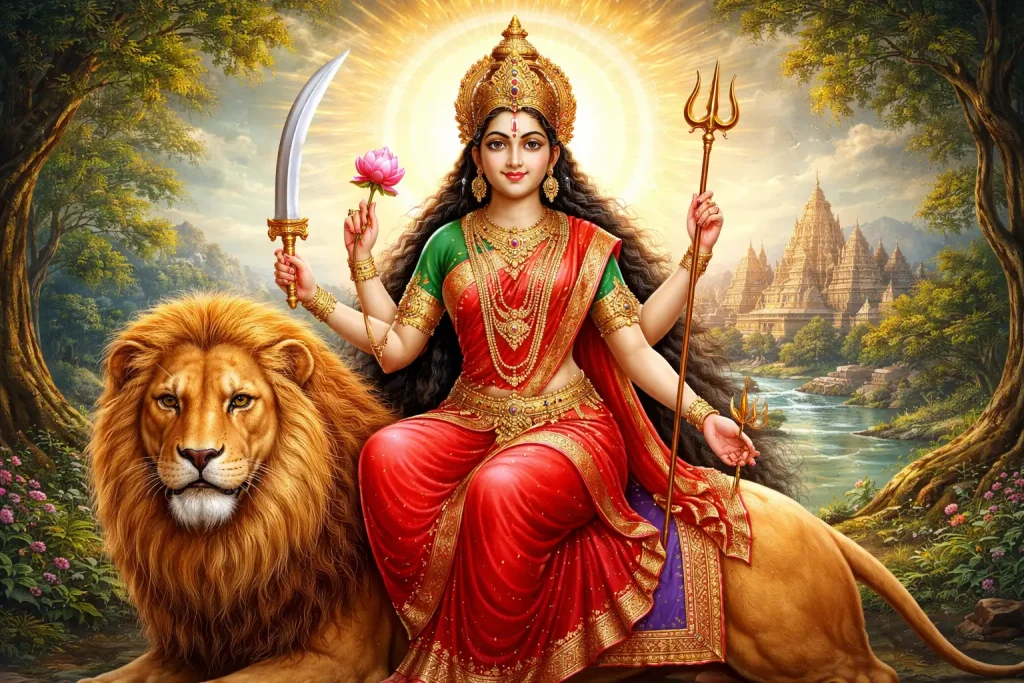
Maa Katyayani is perhaps the most dramatically compelling of the nine Devi — a goddess born specifically for the purpose of destroying the cosmic demon Mahishasura. According to the Devi Mahatmya, when Mahishasura’s tyranny became unbearable even to the devas, the combined fury of all the gods blazed forth from their bodies in a concentrated column of divine light. That radiant energy took the form of Katyayani — fierce, lion-mounted, and terrible in her power.
She is called Katyayani because she first manifested in the hermitage of the sage Katyayana, who had long prayed for the Goddess to be born as his daughter. She honoured that prayer by appearing in his ashram before charging directly into battle. She is depicted with four arms, carrying a sword and a lotus, with the other two hands in the gestures of blessings and fearlessness. Her complexion is golden and her lion reflects her untameable warrior nature.
The Bhagavata Purana reveals an equally extraordinary dimension: the Gopis of Vrindavan — the cowherd maidens devoted to Krishna — performed the Katyayani vrata, worshipping her through the month of Margashirsha to pray that Krishna would become their husband. This connects Katyayani uniquely to the bhakti tradition and to the power of pure, devoted longing. For modern devotees, she represents the courage to face injustice, the willingness to act in the face of darkness, and the divine assurance that righteousness ultimately prevails.
Primary Mantra: Chandrahasojjvalakara Shardulavar Vaahana | Katyayani Shubham Dadhyad Devi Danavaghatini ||
चन्द्रहासोज्ज्वलकर शार्दुलवर वाहना | कात्यायनी शुभं दध्याद् देवि दानवघातिनी ||
Offering & practice: Honey is the sacred offering on the sixth day. Red — blood, passion, life force, and righteous fury — is the colour of Katyayani’s day, worn to invoke her fierce and protective grace.
7. Maa Kalaratri (Day 7)
| Aspect | Details |
|---|---|
| Day | Seventh (Saptami) |
| Colour | Blue / Black |
| Vehicle | Donkey |
| Symbols | Fierce form, three eyes, weapons |
| Planet | Saturn (Shani) |
| Blessing | Protection & Fearlessness |
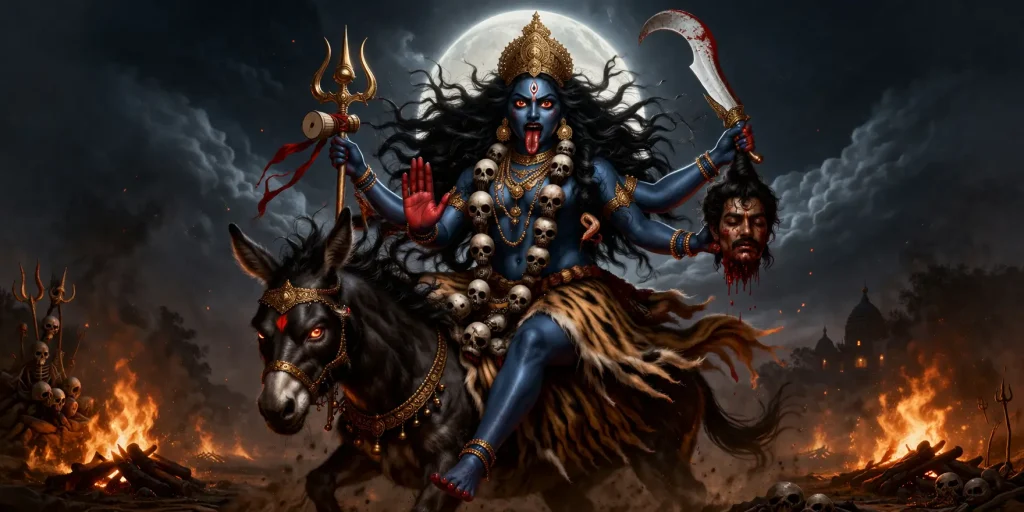
Maa Kaalratri is the most awe-inspiring — and initially the most challenging to encounter — of all the Navdurga forms. She is dark as the night sky, with blazing red eyes, wild and unbound hair, and an expression of terrible power. She is also called Shubhankari — the doer of good — yet she appears in her most fearsome aspect to destroy what must be destroyed: illusion, ego, and demonic forces that cannot be dissolved by gentler means.
Her appearance is described in the Devi Mahatmya as emerging from the brow of Goddess Ambika when the demons Chanda and Munda advanced against her. The Goddess’s face darkened with divine fury, and from that darkness emerged Kaalratri — black as kohl, wearing a garland of skulls, tongue blazing, eyes like suns. She destroyed the demon armies with her bare hands before Ambika could even raise her weapons.
Yet within this terrifying exterior lies supreme compassion. Her vehicle is the humble donkey — the most ordinary, unglamorous of animals — signifying that she is accessible to the most common devotee, not only to the learned or the spiritually advanced. One hand is raised in abhaya mudra (fearlessness) and another in varada mudra (bestowing boons). Her ferocity is directed only at evil, never at the sincere seeker. Kaalratri teaches the hardest and most liberating truth: that the destruction of ego-illusion, though it feels like a kind of death, is the gateway to the greatest freedom. She is the dark night before the dawn.
Primary Mantra: Ekaveeni Japakarna Poora Nagna Kharasthita | Lamboshthi Karnikaname Tailabhyaktashareerinee ||
एकवीनी जपकर्ण पूरा नग्न खरास्थिता | लम्बोष्ठि कर्णिकानामे तैलभ्यक्तशरीरिणी ||
Offering & practice: Jaggery (gur) is the traditional offering to Kaalratri. Black or royal blue — colours of infinite depth, the sky from which all creation emerges, and the night that precedes all dawns — is worn on this seventh day.
8. Maa Mahagauri (Day 8)
| Aspect | Details |
|---|---|
| Day | Eighth (Ashtami) |
| Colour | Pink |
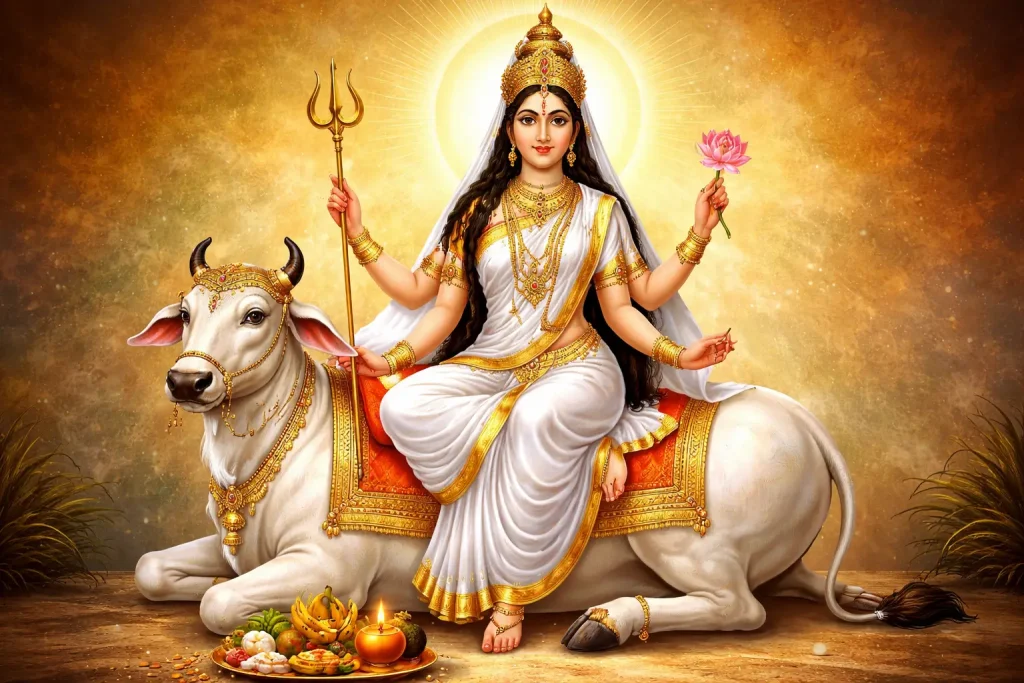
| Vehicle | Bull |
| Symbols | Trident & damaru |
| Planet | Rahu |
| Blessing | Purity, Compassion & Prosperity |
After the terrifying darkness of Kaalratri comes Maa Mahagauri — luminously white, supremely serene, and radiant beyond all description. The contrast is intentional and theologically perfect: after the ego has been shattered by Kaalratri’s transformative fire, what remains is the pure, primordial soul — and Mahagauri is the goddess of that soul’s original whiteness.
Her name tells the story: maha (great) + gauri (white/fair/radiant). According to the Shiva Purana, Parvati’s skin became darkened during her years of severe austerity. When Shiva finally accepted her as his bride, he bathed her body with the sacred waters of the Ganga — and in that act of divine love, she was restored to her original, shining complexion, more radiant than before. Mahagauri is that restored radiance — the soul purified by honest suffering and made brilliant by grace.
She is depicted entirely in white, riding a white bull, carrying a trident and the small drum (damaru) associated with Shiva — symbols of her eternal reunion with her Lord. Ashtami is considered the most sacred day of Navratri in many regional traditions, and devotees who worship Mahagauri on this day are said to have all accumulated sins dissolved and all sincere desires fulfilled. The tradition of Ashtami Havan — a sacred fire ritual — is considered extraordinarily potent for purification and the dissolution of past karma.
Primary Mantra: Shwete Vrishesamarudha Shwetaambaradhara Shuchih | Mahagauri Shubham Dadhyanmahadeva Pramodada ||
श्वेते वृषेसमारूढ़ा श्वेताम्बरधरा शुचिः | महागौरी शुभं दध्यानमहादेव प्रमोददा ||
Offering & practice: Coconut is the revered offering on Ashtami — its pure white interior a mirror of the goddess’s own inner radiance. Pink or rose — tender, compassionate, and spiritually luminous — is the colour of this day.
9. Maa Siddhidatri (Day 9)
| Aspect | Details |
|---|---|
| Day | Ninth (Navami) |
| Colour | Purple |
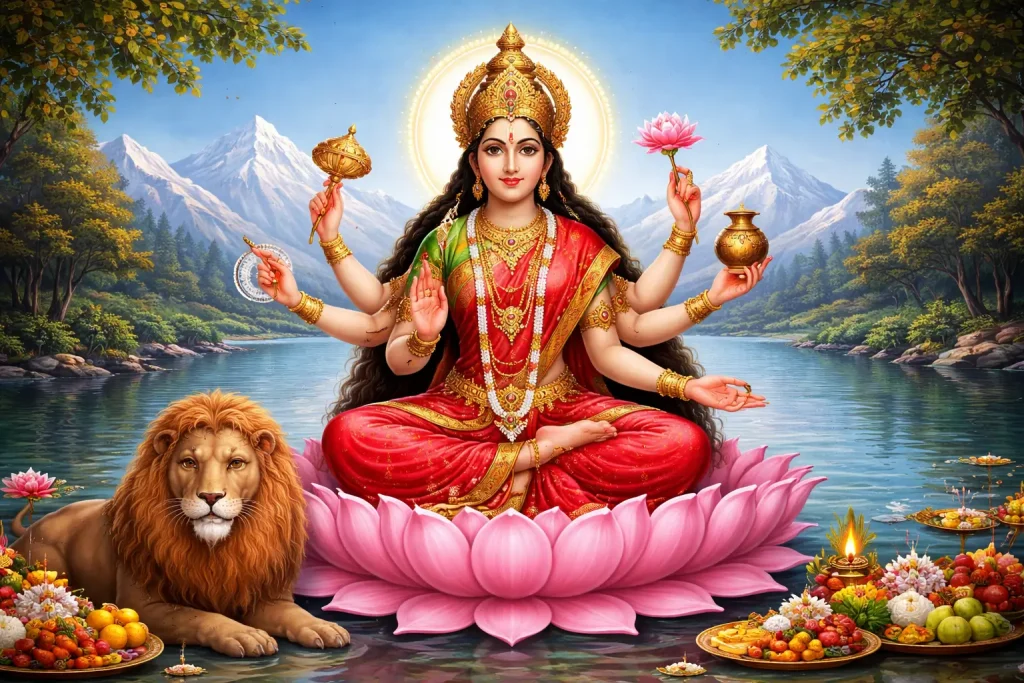
| Vehicle | Lotus |
| Symbols | Four arms, holding mace & discus |
| Planet | Ketu |
| Blessing | Wisdom, Success & Fulfillment |
he final and most complete of the Navdurga is Maa Siddhidatri — she who grants all siddhis (spiritual attainments and perfections). The Devipurana lists eight primary siddhis she can bestow: Anima (becoming infinitely small), Mahima (becoming infinitely large), Garima (becoming infinitely heavy), Laghima (becoming weightless), Prapti (obtaining anything desired), Prakamya (fulfilling any wish), Ishtiva (supreme lordship), and Vashitva (mastery over all forces).
But beyond these extraordinary capacities, Siddhidatri represents something even more profound: the completion of the spiritual journey itself. Having travelled through the nine days — from grounding through austerity, courage, creativity, maternal love, warrior fierceness, the dissolution of ego, and the restoration of radiance — the devotee arrives at the ninth day purified and ready to receive the fullness of divine grace.
Maa Siddhidatri is worshipped by gods, sages, humans, and even demons — all created beings who seek perfection. She is depicted seated on a fully bloomed lotus, carrying a mace (gada), discus (chakra), conch shell (shankha), and lotus. According to the Skanda Purana, even Lord Shiva received his famous half-female, half-male form (ardhanarishvara) as a siddhi granted by Maa Siddhidatri. She is therefore the source from which even divine perfection flows.
The ninth day of Navratri culminates in the beautiful ritual of Kanya Pujan — the worship of young girls as living embodiments of the Goddess — one of the most egalitarian and moving expressions of the entire Navratri festival.
Primary Mantra: Siddha Gandharva Yakshaadyair Asurairmartyairapi | Sevyamaana Yada Devi Siddhida Siddhidabhaveth ||
सिद्ध गंधर्व यक्षाद्यैर असुरैरमर्त्यैरपि | सेव्यमाना यदा देवि सिद्धिदा सिद्धिदाभवेत् ||
Offering & practice: Sesame seeds (til) and halwa are the traditional offerings on Navami. Purple or violet — the colour of spiritual completion, mystical insight, and cosmic awareness — is worn to honour Siddhidatri on this culminating day of Navratri.
Rituals of Navratri Puja
- Ghatasthapana (Kalash Sthapana): Performed on Day 1 to invoke Goddess Durga.
- Daily Puja: Each day devotees offer flowers, fruits, sweets, and chant mantras dedicated to the respective Devi.
- Fasting: Many observe fasts, consuming only sattvic foods like fruits, milk, and vrat-friendly flours.
- Kanya Pujan: On Ashtami or Navami, young girls are worshipped as embodiments of the goddess.
- Aarti & Bhajans: Devotees perform aarti and sing devotional songs daily.
Cultural Importance
- In North India, Navratri is marked by Ram Lila and Dussehra celebrations.
- In West India (Gujarat, Maharashtra), Garba and Dandiya dances are performed.
- In South India, Golu (doll displays) are arranged in homes.
- In East India (West Bengal, Assam), Durga Puja is celebrated with grandeur.
Conclusion
The nine Devi of Navratri—Shailaputri, Brahmacharini, Chandraghanta, Kushmanda, Skandamata, Katyayani, Kalaratri, Mahagauri, and Siddhidatri—represent different aspects of divine feminine energy. Worshipping them during Navratri brings strength, wisdom, prosperity, and protection. Observing the rituals with devotion ensures spiritual fulfillment and honors the timeless tradition of celebrating Goddess Durga’s victory over evil.
I am Disha Sharma the founder and writer of Great Indian Festival with a passion for storytelling and a dedication to sharing knowledge, I create content that informs, inspires, and connects with readers. My writing reflects creativity, clarity, and a commitment to delivering valuable insights across topics that matter.