|
Getting your Trinity Audio player ready...
|
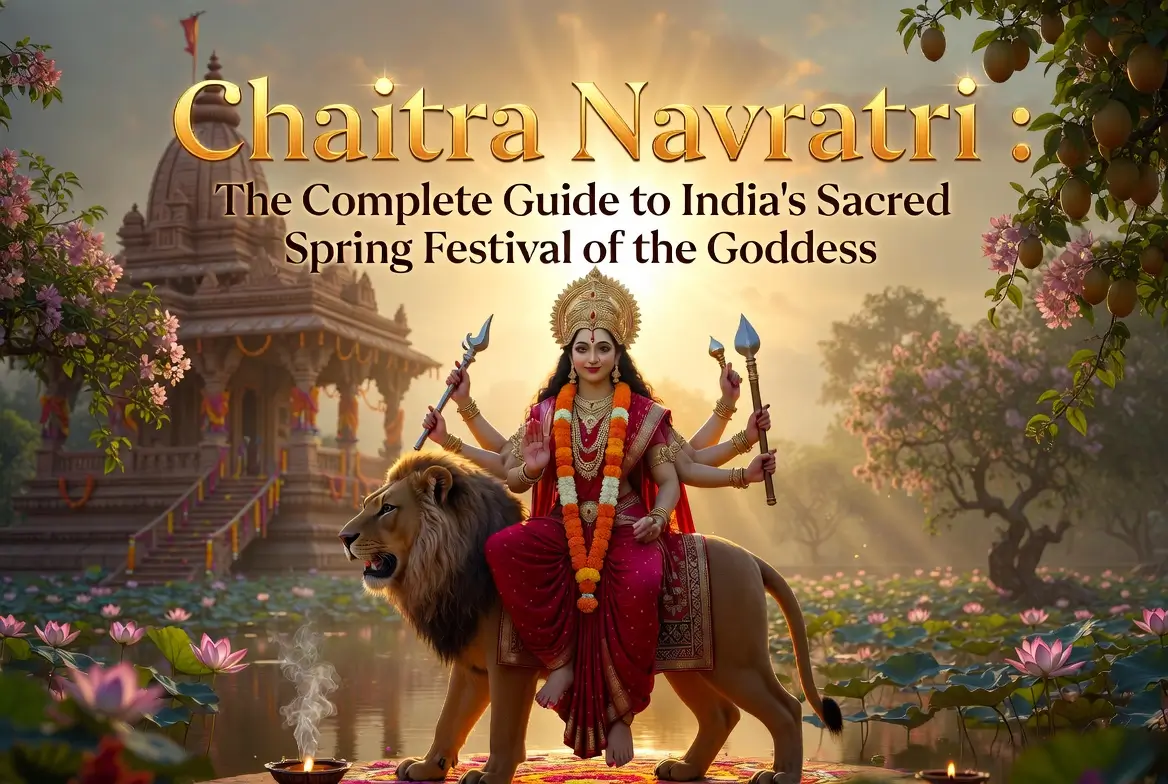
Every spring, before the mango trees have fully blossomed and the nights still carry the last chill of February, something shifts in the Hindu household. The puja room gets a deeper cleaning than usual. Red and orange marigolds appear on doorsteps. The smell of fresh dhoop drifts out of windows before sunrise. Barley seeds are soaked overnight, ready to be sown into a clay pot of earth.
Chaitra Navratri has arrived.
For those who have grown up inside this festival, no explanation is necessary — it lives in the body as much as the mind, a nine-day rhythm of early mornings, lamp-lit evenings, simple food, and devotional chanting that feels as natural and as necessary as the changing of the season itself. For those coming to it for the first time — whether as someone reconnecting with a family tradition, a student of Hindu philosophy, or simply a curious reader — Chaitra Navratri can feel like a vast, layered subject that resists easy summary.
This guide is an attempt at both: a thorough, honest, and deeply human introduction to one of Hinduism’s most profound festivals — covering its history, mythology, calendar, the nine forms of the Goddess worshipped day by day, the fasting traditions, the regional variations, the spiritual philosophy, and the practical guidance for observing it at home.
What Is Chaitra Navratri? Understanding the Festival
Chaitra Navratri (चैत्र नवरात्रि) is a nine-night Hindu festival observed during the month of Chaitra in the Hindu lunar calendar — which typically falls in March or April in the Gregorian calendar. The word comes from two Sanskrit roots: Nav (nine) and Ratri (night), making Navratri literally “nine nights.”
During these nine nights and the ten days they span, Hindus across India and the global diaspora worship Shakti — the supreme divine feminine power — in her nine manifestations, collectively called Navadurga (the nine Durgas). The festival culminates on the tenth day with Ram Navami, the birth anniversary of Lord Rama, the seventh avatar of Vishnu.
Chaitra Navratri Among the Four Annual Navratris
Many people are surprised to learn that there are not one but four Navratris in the Hindu calendar year:
Chaitra Navratri (March–April): The spring Navratri, marking the Hindu New Year and one of the most sacred of the four. Most widely observed in North India.
Sharad Navratri (September–October): The autumn Navratri, the most publicly celebrated — associated with Durga Puja in Bengal, Garba in Gujarat, and Dussehra across India.
Magha Navratri (January–February): Also called Gupta Navratri (secret Navratri); observed by specific Shakta communities and Tantric practitioners.
Ashadha Navratri (June–July): The monsoon Navratri, also called Gupta Navratri; less widely observed publicly.
Chaitra and Sharad are the most widely observed. But for devoted Shaktas and many North Indian families, Chaitra Navratri carries a special primacy — the Devi Bhagavata Purana describes it as the foundational Navratri, the one from which all others derive their significance.
Why Chaitra Navratri Is Different from Sharad Navratri
While both Navratris worship the same nine forms of the Goddess, their character, atmosphere, and cultural expressions are quite different:
Sharad Navratri is public, festive, and outward — Garba dances until midnight in Gujarat, massive illuminated pandals in Bengal, Dandiya nights across the country. It is the Navratri of spectacle and community celebration.
Chaitra Navratri is inward, devotional, and personal. It is the Navratri of daily puja at home, of strict fasting, of reading the Durga Saptashati in the quiet of the morning, of pilgrimage to mountain temples, and of the Kanya Puja that brings the Goddess into the home as a living child. It is less photographed but, for those who observe it deeply, often more spiritually nourishing.
Chaitra Navratri 2026: Dates and Calendar
Chaitra Navratri begins on the Pratipada (first day of the bright fortnight) of the Chaitra month and runs for nine days. Based on the Hindu Panchang, Chaitra Navratri 2026 is expected to begin on approximately March 30, 2026, with Ram Navami falling around April 7, 2026. As with all Hindu festivals, the precise date should be confirmed with a local Panchang or temple as it depends on the exact timing of the Tithi at sunrise in your location.
Day-by-Day Calendar of Chaitra Navratri
Each of the nine days is dedicated to a specific form of Goddess Durga, associated with a particular color, mantra, and offering:
| Day | Tithi | Goddess | Meaning | Color |
|---|---|---|---|---|
| 1 | Pratipada | Shailaputri | Daughter of the Mountain | Yellow |
| 2 | Dwitiya | Brahmacharini | The Ascetic Devotee | Green |
| 3 | Tritiya | Chandraghanta | Moon-Bellied Warrior | Grey |
| 4 | Chaturthi | Kushmanda | Creator of the Universe | Orange |
| 5 | Panchami | Skandamata | Mother of Skanda | White |
| 6 | Shashthi | Katyayani | The Warrior Goddess | Red |
| 7 | Saptami | Kalaratri | The Dark Night | Royal Blue |
| 8 | Ashtami | Mahagauri | The Pure White Goddess | Pink |
| 9 | Navami | Siddhidatri | Bestower of Perfection | Purple |
| 10 | Dashami | Ram Navami | Birth of Lord Rama | — |
The History and Origins of Chaitra Navratri
The Scriptural Foundation
Chaitra Navratri draws its religious authority primarily from three Sanskrit texts:
The Devi Mahatmya (also called the Durga Saptashati or Chandi Path): A 700-verse text embedded in the Markandeya Purana, composed between the 4th and 7th centuries CE. It is the most important scripture of the Shakta tradition and is recited during Navratri in its entirety. The text opens with a king named Suratha who loses his kingdom and performs the first Navratri worship during the spring season — making Chaitra Navratri the “original” Navratri in textual terms.
The Devi Bhagavata Purana: An extensive Purana dedicated entirely to the Goddess, which contains the mythology of the Navadurga forms, the Shakti Peeths, and elaborate instructions for Navratri worship.
The Kalika Purana: A text from Assam that provides the Tantric dimensions of goddess worship, particularly relevant to the northeastern traditions of Chaitra Navratri.
The Astronomical Roots
Chaitra Navratri is not only a religious festival — it is also a sophisticated astronomical observance. It falls during the Vasant Ritu (spring season), at the junction of the sun’s northward journey (Uttarayana). This is the period of the vernal equinox, when day and night are equal and the sun begins to dominate over darkness.
In Vedic cosmology, this moment is auspicious for spiritual practice precisely because the solar energy — which represents consciousness, clarity, and vitality — is at its most potent growth point. The nine days of Navratri harness this cosmic energy through focused worship, creating an alignment between the individual’s spiritual practice and the larger rhythms of the natural world.
This is also why Chaitra Navratri coincides with the Hindu New Year celebrations across many regional traditions — Ugadi in Karnataka and Andhra Pradesh, Gudi Padwa in Maharashtra, Bihu in Assam, and Baisakhi in Punjab all cluster around this same astronomical moment.
The Nine Forms of Goddess Durga (Navadurga): A Deep Dive
The sequential worship of the nine forms of Durga is the devotional and spiritual heart of Chaitra Navratri. Each form is not a separate goddess but a different facet of the same supreme feminine power — like nine different wavelengths of the same light. Understanding each form transforms the nine days from a repetitive ritual into a progressive inner journey.
Day 1 — Maa Shailaputri: The Daughter of the Mountain
Sanskrit name: Shaila (mountain) + Putri (daughter)
Iconography: Shailaputri rides the bull Nandi, carries a trident in her right hand and a lotus in her left, and wears a crescent moon on her forehead. She is dressed in white and radiates a gentle, grounded energy.
Mythology: In her previous life, Shailaputri was Sati, the daughter of Daksha and the first wife of Lord Shiva. When Daksha insulted Shiva and excluded him from a grand yajna, Sati could not bear the dishonor to her husband and immolated herself in the sacred fire. In her next birth, she was reborn as Parvati, the daughter of Himavan (King of the Himalayas). Shailaputri represents this rebirth — the soul’s return after death, the beginning of a new cycle.
Spiritual teaching: As the first of nine, Shailaputri corresponds to the Muladhara (root) chakra — the energy center at the base of the spine associated with groundedness, stability, and connection to the earth. Worshipping her on the first day establishes the spiritual foundation for everything that follows. She teaches that any genuine inner journey must begin with rootedness — you cannot ascend without first being deeply grounded.
Mantra: Om Devi Shailaputryai Namah Offerings: White flowers, milk, white sweets (especially white pedha) Color: Yellow — representing happiness and the brightness of new beginnings
Day 2 — Maa Brahmacharini: The Ascetic Devotee
Sanskrit name: Brahma (the supreme, or tapas/austerity) + Charini (one who practices)
Iconography: Brahmacharini walks barefoot in white garments, carrying a rudraksha mala (rosary) in her right hand and a kamandal (water pot) in her left. She wears no jewelry and carries no weapons — the goddess stripped of all adornment, fully absorbed in austerity.
Mythology: This form represents Parvati during the extraordinary period of tapas she undertook to win Shiva as her husband. The Shiva Purana describes her discipline in staggering detail: she lived for years on only leaves, then only on water, then abstained from water, then stood on one leg for thousands of years, enduring heat, cold, and rain without shelter. Even the gods were moved. Eventually, Shiva relented and accepted her.
Spiritual teaching: Brahmacharini teaches that the highest spiritual attainments are not given but earned through sustained, focused discipline. She corresponds to willpower and renunciation — not the grim kind, but the joyful surrender of lesser pleasures for greater ones. On Day 2, devotees are encouraged to reflect on what they are willing to give up in service of what matters most.
Mantra: Om Devi Brahmacharinyai Namah Offerings: Sugar, panchamrit (milk, curd, honey, ghee, and sugar) Color: Green — representing growth, vitality, and the energy of determined practice
Day 3 — Maa Chandraghanta: The Moon-Bellied Warrior
Sanskrit name: Chandra (moon) + Ghanta (bell)
Iconography: Chandraghanta is golden in complexion, rides a tiger, and has ten arms bearing eight weapons plus the Varada (blessing) and Abhaya (fearlessness) mudras. A half-moon shaped like a bell — the crescent moon in the bell-shape position — adorns her forehead. Her expression is fierce but also deeply benevolent.
Mythology: After Parvati’s marriage to Shiva, she adorned her forehead with the half-moon (just as Shiva wears the full moon), taking on the married woman’s right to wear this lunar symbol. When Shiva arrived at the wedding in his wild ascetic form — surrounded by ghosts, his matted hair wild, his body smeared with ash — it frightened Parvati’s family. Chandraghanta is the form Parvati took to mediate between Shiva’s wildness and the world’s expectations, embodying grace in the midst of chaos.
Spiritual teaching: Chandraghanta teaches courage paired with grace. She corresponds to the Manipura (solar plexus) chakra — the seat of personal power and self-confidence. She is particularly significant for those dealing with fear, anxiety, or the need to stand their ground in difficult situations.
Mantra: Om Devi Chandraghantayai Namah Offerings: Kheer (rice pudding), white flowers, honey Color: Grey — representing strength, balance, and the calm at the eye of a storm
Day 4 — Maa Kushmanda: The Cosmic Creator
Sanskrit name: Ku (small, primordial) + Ushma (energy, warmth) + Anda (cosmic egg)
Iconography: Kushmanda has eight arms, rides a lion, and radiates a dazzling, sun-like golden light. She holds a kamandal, a bow, arrows, a discus, a mace, a lotus, and a jar of amrita (divine nectar), and one hand is in the Varada mudra.
Mythology: Kushmanda is the only Navadurga form explicitly associated with creation. Before creation, there was only infinite darkness and void. Kushmanda smiled — and from her divine smile, the universe was created. She thus precedes the entire pantheon; Brahma, Vishnu, and Shiva emerge from her creative act. The word Kushmanda is also Sanskrit for pumpkin (the vegetable), and offerings of pumpkin are made to her.
Spiritual teaching: Kushmanda embodies the teaching that creation is an act of joy — the universe didn’t emerge from labor or necessity but from the spontaneous bliss of the Goddess’s smile. She corresponds to the Anahata (heart) chakra. Worshipping her opens the heart to creative energy, removes chronic sorrow, and restores the fundamental joy that underlies existence.
Mantra: Om Devi Kushmandayai Namah Offerings: Pumpkin, malpua (sweet pancakes), honey Color: Orange — representing creativity, energy, and the warmth of the cosmic sun
Day 5 — Maa Skandamata: The Divine Mother
Sanskrit name: Skanda (Kartikeya, the god of war) + Mata (mother)
Iconography: Skandamata has four arms and sits either on a lotus or rides a lion. She holds the infant Kartikeya in her lap and in her arms. She radiates brilliant white light — the pure luminosity of unconditional maternal love.
Mythology: Kartikeya (Skanda) was born for a specific divine purpose — to defeat the demon Tarakasura, who had obtained a boon that only Shiva’s son could kill him. Skandamata is the goddess in her role as the mother of the warrior god — but also, by extension, the divine mother of every soul engaged in the spiritual battle against inner demons.
Spiritual teaching: Skandamata teaches that nurturing is itself a form of power. Her worship corresponds to the Vishuddhi (throat) chakra — the center of authentic expression and truth-speaking. She is particularly worshipped by mothers seeking health and protection for their children, and by those seeking to develop the quality of compassionate wisdom.
Mantra: Om Devi Skandamatayai Namah Offerings: Bananas, white sweets, lotus flowers Color: White — representing purity, clarity, and the selfless nature of genuine love
Day 6 — Maa Katyayani: The Warrior of Fierce Devotion
Sanskrit name: Born as the daughter of the sage Katyayana
Iconography: Katyayani has a golden complexion, four arms, rides a lion, and carries a sword and a lotus. Her expression is fierce — this is the Goddess fully in her warrior aspect, ready for battle.
Mythology: When the combined might of all the gods failed to stop Mahishasura, the buffalo demon who had seized the three worlds, all the gods poured their individual energies together. From this union of all divine power emerged Katyayani — not gentle, not maternal, but fierce, armed, and purposeful. She is also the form worshipped by the Gopis (cowherd women) of Vrindavan in the Bhagavata Purana, who prayed to her during Kartika month to receive Lord Krishna as their husband — demonstrating that this warrior form is also the goddess of the deepest longing of the devotional heart.
Spiritual teaching: Katyayani teaches that love and fierceness are not opposites — that the deepest love is fierce in its protection of what it values. She corresponds to the Ajna (third eye) chakra. She destroys ego, destroys the fear of judgment, and clears the obstacles between the devotee and their highest aspiration. Unmarried women traditionally worship her for a virtuous and loving partner — following the tradition of the Gopis.
Mantra: Om Devi Katyayanyai Namah Offerings: Honey, red flowers, sindoor (vermilion) Color: Red — representing passion, courage, and the fire of devoted love
Day 7 — Maa Kalaratri: The Fierce Face of Darkness
Sanskrit name: Kala (dark, or time/death) + Ratri (night)
Iconography: Kalaratri is the most fearsome of all Navadurga. She is dark as midnight, with three blazing eyes, four arms holding a sword and a torch while showing Varada and Abhaya mudras. Her hair is unbound and wild. Flames emerge from her breath. She rides a donkey.
Mythology: When the demons Shumbha and Nishumbha sent the nearly invincible Raktabija to battle the Goddess, Durga’s wrath became so intense that her face turned black and from her forehead emerged Kali — the limitless, unchained, primordial aspect of the Goddess. Kalaratri is this force. She is the goddess who has removed every adornment, every softening, every compromise with beauty — leaving only pure, terrifying, liberating reality.
Spiritual teaching: Kalaratri is the hardest form to worship and the most transformative. She corresponds to the Sahasrara (crown) chakra — the seat of cosmic consciousness. She teaches that darkness is not evil but necessary — that transformation requires the destruction of what has outlived its purpose, that the ego’s deepest illusions must be dissolved before the light of the next day can emerge. Despite her terrifying appearance, she bears the name Shubhankari — the one who brings auspiciousness — because her destruction is always in service of grace.
Mantra: Om Devi Kalaratryai Namah Offerings: Jaggery, red flowers, mustard oil lamp Color: Royal Blue — representing infinite depth, cosmic vastness, and the transformative power of night
Day 8 — Maa Mahagauri: The Radiant Dawn After Darkness
Sanskrit name: Maha (great) + Gauri (white, luminous, fair)
Iconography: Mahagauri is entirely white — white garments, white ornaments, white bull. She has four arms carrying a trident and damaru (drum) while displaying Varada and Abhaya mudras. After the terrifying darkness of Kalaratri, Mahagauri is the luminous peace that follows.
Mythology: After Parvati’s long years of austerity, her skin had darkened from constant exposure to the harsh elements of her tapas. When she and Shiva were finally united, Shiva bathed her in the sacred waters of the Ganga — and her original, brilliant white complexion was restored. Mahagauri is that restored radiance — the purity that emerges not from having avoided darkness but from having passed through it and been cleansed.
Spiritual teaching: Mahagauri is worshipped on Ashtami — the eighth and most powerful day of Navratri — precisely because her purity follows Kalaratri’s darkness. She teaches that purity is not innocence but wholeness — the luminous self that exists not despite one’s difficult experiences but because of them. She cleanses accumulated karma, soothes old wounds, and restores the soul’s original brightness.
Mantra: Om Devi Mahagauryai Namah Offerings: Coconut, white flowers, white sweets, milk Color: Pink — representing healing, compassion, and the tenderness of restored wholeness
Day 9 — Maa Siddhidatri: The Bestower of All Perfections
Sanskrit name: Siddhi (perfection, supernatural attainment) + Datri (bestower)
Iconography: Siddhidatri sits in full lotus on a lotus flower, surrounded by Siddhas (perfected beings), gods, and devoted seekers of all descriptions. She has four arms carrying a lotus, a mace, a conch, and a discus. Her expression is serene and completely fulfilled — the most peaceful of all nine forms.
Mythology: The Devi Bhagavata Purana describes eight Siddhis (supernatural perfections) that Siddhidatri can grant: Anima (the ability to become infinitely small), Mahima (to become infinitely large), Garima (to become infinitely heavy), Laghima (to become weightless), Prapti (to access anything), Prakamya (to realize all desires), Ishitva (sovereign will), and Vashitva (complete mastery). Lord Shiva himself received the left half of his body as the Goddess through her grace — becoming Ardhanarishvara, the cosmic form in which masculine and feminine are unified.
Spiritual teaching: Siddhidatri is the culmination of the nine-day inner journey. Having established groundedness with Shailaputri, cultivated discipline with Brahmacharini, gathered courage with Chandraghanta, opened to joy with Kushmanda, developed compassion with Skandamata, engaged fiercely with Katyayani, faced darkness with Kalaratri, and been purified by Mahagauri — the devotee now stands before the Goddess as the Giver of Everything. She teaches that all perfection is available not to those who seek power, but to those who have emptied themselves of ego through nine days of genuine devotion.
Mantra: Om Devi Siddhidatryai Namah Offerings: Sesame seeds, lotus flowers, all fruits, kheer Color: Purple — representing spiritual wisdom, completion, and the mystery that transcends all categories
The Mythology Behind Navratri: The Stories That Give It Meaning
The nine days of Chaitra Navratri are not arbitrary — they are rooted in specific mythological narratives from the Devi Mahatmya, the foundational text of the Shakta tradition. Understanding these stories transforms Navratri from ritual into revelation.
The Battle Against Mahishasura
The central Navratri story is the Goddess’s battle against Mahishasura, the buffalo demon. Mahishasura had performed intense austerities and received a boon from Brahma: no man, no god, no force in the universe could kill him. Armed with this invincibility, he drove the gods from heaven and declared himself the ruler of the three worlds.
The gods gathered and each poured their individual power — Vishnu’s discus, Shiva’s trident, Indra’s thunderbolt, Agni’s fire, Vayu’s winds — into a single stream of divine energy. From this union of all cosmic power emerged a radiant female form: Goddess Durga, riding a lion, bearing eighteen arms, each carrying a divine weapon, her form blazing with the light of ten thousand suns.
Mahishasura was not even afraid. When he saw a woman, he sent emissaries to propose marriage — the ultimate expression of the ego’s conviction that the Goddess, like everything else, can be possessed.
For nine days and nights, the battle raged. The demon took many forms — buffalo, lion, man, elephant — but the Goddess met each transformation with perfect countermeasure. On the tenth day — celebrated as Vijayadashami — Durga slew Mahishasura.
This story is not merely a supernatural adventure. The buffalo demon represents the tamasic ego — the dull, animalistic, power-hungry self that refuses to acknowledge a reality higher than its own appetites. The Goddess represents Shakti — the cosmic intelligence that such an ego cannot contain or comprehend. The nine days of Navratri are the battle. Ram Navami, or Vijayadashami in Sharad, is the victory.
The Devi Mahatmya’s Frame Story: The First Navratri
The Devi Mahatmya opens with a frame narrative that has particular relevance for Chaitra Navratri. A king named Suratha has been driven from his kingdom by treacherous ministers. A merchant named Samadhi has been abandoned by his family despite his love for them. Both arrive at the ashram of the sage Medha, bewildered by their suffering.
Medha tells them the story of the Goddess — the Devi Mahatmya’s three great narratives — and then instructs Suratha and Samadhi to worship the Goddess during the spring season (the Chaitra period). They retreat to the forest, make a clay image of the Goddess, and perform nine days of worship — fasting, reciting the Devi’s hymns, making offerings.
At the end of nine days, the Goddess appears. She grants Suratha the restoration of his kingdom and, in a future birth, the honor of being the Manu (progenitor of a cosmic age). She grants Samadhi the liberation of his soul from the cycle of attachment and rebirth.
This is the scriptural template for Chaitra Navratri. It establishes that this spring Navratri was the first Navratri — the original template performed by a king and a merchant in the forest, not by gods or sages, but by ordinary human beings in crisis who found in the Goddess an answer that reason alone could not provide.
Chaitra Navratri Fasting: The Complete Vrat Guide
Fasting during Chaitra Navratri — the Navratri vrat — is one of the most widely practiced Hindu fasting traditions. It is observed by hundreds of millions of people across India, from the Himalayas to Kanyakumari, adapting to regional customs but maintaining a remarkable core consistency.
The Purpose of Navratri Fasting
Navratri fasting is not deprivation as punishment. It is a deliberate, intentional reorientation of the body, mind, and spirit toward the divine during the nine sacred days. Its purposes, understood across multiple frameworks, are:
Devotional: The fast is an offering to the Goddess — a tangible demonstration of love and surrender. By denying the body its habitual pleasures, the devotee communicates to the Goddess that she matters more than comfort.
Physical/Ayurvedic: Chaitra Navratri falls precisely at the seasonal junction Ayurveda considers most significant for health — the shift from Shishir (late winter) to Vasant (spring). During this transition, the body naturally benefits from lighter, easier-to-digest foods as the digestive fire recalibrates for the new season. The Navratri fast food list is, almost perfectly, an Ayurvedic spring cleansing diet.
Psychological: The discipline of fasting — especially food-specific fasting with clear rules — trains the mind’s capacity to say no to impulse. This discipline, practiced over nine days, creates inner clarity and strengthens the willpower that the rest of the year’s spiritual practice requires.
What Is Avoided During Navratri Vrat
The Navratri fast works by exclusion — specifying what is not eaten, leaving a wide and genuinely nourishing range of foods that can be eaten:
Prohibited during Navratri vrat:
- Regular wheat flour (both maida and atta)
- Polished rice (in most North Indian traditions)
- Common table salt — replaced by sendha namak (rock salt or Himalayan pink salt)
- Onion and garlic (both considered rajasic/tamasic foods in Ayurveda)
- Non-vegetarian food (meat, fish, eggs)
- Alcohol
- Pulses and lentils
- Refined sugar in some strict observances
- Processed or packaged foods
What Can Be Eaten: The Navratri Vrat Food List
Despite these restrictions, the Navratri vrat kitchen is surprisingly rich:
Flours and grains:
- Kuttu ka atta (buckwheat flour) — for rotis, pooris, pakoras, chilla
- Singhare ka atta (water chestnut flour) — for rotis, halwa, pakoras
- Rajgira/Ramdana (amaranth flour) — for rotis, laddoos, chikki
- Samak ke chawal (barnyard millet) — used as rice substitute for khichdi and kheer
Other staples:
- Sabudana (sago/tapioca pearls) — for khichdi, kheer, vada, papad
- Makhana (lotus seeds/fox nuts) — roasted as snacks, in kheer
- Potatoes and sweet potatoes
- All fresh vegetables except onion and garlic
Dairy:
- Milk, full-fat curd, paneer, ghee — all permitted and encouraged
Fruits and nuts: All fruits, all dry fruits and nuts
The Best Navratri Vrat Recipes
The Navratri vrat kitchen has generated some of North India’s most distinctive and delicious dishes:
Sabudana Khichdi The iconic Navratri dish. Soaked sago pearls cooked with ghee, cumin seeds, green chili, crushed roasted peanuts, and sendha namak until each pearl is translucent and separate. Achieving perfectly non-sticky sabudana khichdi is a point of considerable culinary pride in North Indian households. The secret is soaking the sabudana for at least 4–6 hours (or overnight) and draining it thoroughly before cooking.
Kuttu Puri Buckwheat flour puris, deep-fried in ghee — slightly earthy, nutty, and deeply satisfying. Served with aloo sabzi made with sendha namak, cumin, and green chili. The combination of kuttu puri and aloo is the quintessential Navratri meal across North India.
Samak Rice Khichdi Barnyard millet cooked simply with ghee, jeera, green chili, and sendha namak — lighter than regular rice with a pleasant, slightly nutty texture. An excellent complete meal with curd.
Aloo Vrat Sabzi A dry potato curry made with cumin seeds, green chili, fresh coriander, lemon, and rock salt — simple, deeply satisfying, and the most versatile Navratri side dish.
Makhana Kheer Lotus seeds roasted in ghee until golden and puffed, then simmered in full-fat milk with cardamom, saffron, and sugar until rich and fragrant. One of the most elegant Navratri desserts.
Kuttu Ka Halwa Buckwheat flour cooked in ghee until fragrant and golden, then sweetened with jaggery or sugar and flavored with cardamom. Dense, warming, and deeply nourishing.
Rajgira Laddoo Amaranth seeds popped like popcorn, bound together with jaggery syrup, shaped into balls. High in protein, iron, and calcium — a nutritionally excellent Navratri snack.
Singhare Ki Barfi Water chestnut flour fudge made with milk, ghee, sugar, and cardamom — a delicate, mildly flavored sweet uniquely associated with Navratri.
Chaitra Navratri Rituals
The rituals of Chaitra Navratri are layered and rich, with some practices universal across Hindu communities and others specific to regions or family traditions.
Ghatasthapana (Kalash Sthapana): The Opening Ritual
Ghatasthapana — the establishment of the sacred pot — is the most important single ritual of Chaitra Navratri and the one that officially opens the nine-day observance. It must be performed at an auspicious muhurta (timing) on the first day, determined by the local Panchang.
What you need:
- A clay or copper kalash (pot) with a wide mouth
- Holy water (Gangajal is traditional; clean water with a pinch of turmeric is an acceptable substitute)
- Mango leaves (5 or 7, arranged around the kalash mouth)
- An unbroken coconut, wrapped in red cloth and tied with red mauli (sacred thread)
- Clean river soil or garden soil
- Barley seeds (jau)
- Red cloth for the altar
The ritual:
- Spread the soil on a flat tray or shallow vessel and sow the barley seeds evenly and densely
- Fill the kalash with holy water and drop in a few coins and akshata (unbroken rice grains) as symbols of abundance
- Place mango leaves around the mouth of the kalash
- Place the coconut on top, wrapped in its red cloth
- Set the kalash on top of the soil/barley tray
- Perform the formal invocation, calling the Goddess into the kalash with the recitation of the Navarna Mantra: Om Aim Hreem Kleem Chamundayai Vichhe
- Light the diya and offer flowers
The barley seeds will sprout over the nine days, growing into tender green shoots that symbolize the prosperity the Goddess brings. On Navami, the shoots are offered to the Goddess and then distributed to family members as prasad — some families tuck them behind their ears or keep them in a place of honor in the home.
Akhand Jyoti: The Unbroken Flame
Many devout families maintain an Akhand Jyoti — an oil lamp that burns without interruption for all nine days of Navratri. This requires dedicated attention: someone in the household must be responsible for replenishing the oil and ensuring the flame never goes out.
The Akhand Jyoti is not merely symbolic. In Vedic tradition, fire represents consciousness — the divine awareness that is eternal, never born and never extinguished. Maintaining an unbroken flame for nine days is understood as maintaining an unbroken thread of conscious devotion, a continuous offering of attention to the Goddess throughout the festival.
Daily Puja Structure
Morning practice (ideally before sunrise):
- Bathe fully before approaching the puja space
- Dress in clean clothes (preferably the color associated with the day’s Navadurga form)
- Clean and refresh the altar — remove wilted flowers, wipe the kalash, light fresh incense
- Offer fresh flowers — marigold, rose, and red hibiscus are particularly auspicious
- Light the diya
- Recite the specific mantra for the day’s Navadurga form — 108 times using a mala is traditional
- Recite the Navadurga Stotram or the relevant portion of the Durga Saptashati
Evening practice:
- Light the evening diya and incense
- Perform the Aarti — the most widely sung is Jai Ambe Gauri, though many families have their own traditional Aarti
- Offer bhog (the day’s food offering) before eating
- Distribute prasad to all household members
Reading the Durga Saptashati (Durgapath)
Reading the Durga Saptashati — all 700 verses of the Devi Mahatmya — during the nine days of Navratri is one of the most important devotional practices of the festival. The 700 verses are divided across nine days:
- Days 1–3: The First Charitra (Chapters 1–4) — the story of Madhu and Kaitabha
- Days 4–6: The Middle Charitra (Chapters 5–8) — the story of Mahishasura
- Days 7–9: The Last Charitra (Chapters 9–13) — the story of Shumbha, Nishumbha, and Raktabija
The text is traditionally recited in Sanskrit, but Hindi translations with Roman transliterations are now widely available for those without Sanskrit reading ability. Many families listen to recorded Saptashati recitations if they cannot read Sanskrit directly — the devotion in the listening is considered equally valid.
Kanya Puja: Worshipping the Living Goddess
Kanya Puja (also called Kumari Puja or Kanjak in North Indian communities) is one of the most moving and theologically significant rituals of Chaitra Navratri.
On Ashtami (Day 8) or Navami (Day 9) — or both — young girls between approximately 2 and 10 years of age are invited to the home and worshipped as living embodiments of the Goddess. The number is traditionally nine (representing the nine Navadurga), though families invite as many as their space allows.
The ritual:
- The girls arrive in the morning, ideally before breakfast
- Their feet are washed with clean water — the senior woman of the household may touch their feet in reverence
- Red tilak is applied to their foreheads
- They are seated at a place of honor
- They are served the traditional Kanya Puja meal: halwa (semolina pudding), puri (fried flatbread), and kala chana (black chickpeas), with kheer in many households
- After eating, they are gifted — traditionally new clothes, money, or sweets
- The household members seek their blessings
Kanya Puja is the festival’s most direct statement of Shakta philosophy: the divine feminine is not an abstract theological concept but a living reality present in every female being, most purely expressed in the pre-pubescent girl who has not yet been shaped by the world’s expectations. The little girl sitting at your table, eating your halwa and puri, is — in the fullest sense of Shakta theology — the Goddess herself.
Navami Havan: The Concluding Fire Ritual
On the final day — Navami — most observing families perform a havan (sacred fire ritual). A fire is lit in a ceremonially prepared fire pit (kund), and offerings of ghee, sesame seeds, barley, dried coconut, and specific herbs are made into the fire while the priest or senior family member chants Vedic mantras.
The havan represents the culmination of the nine days — the offering of all accumulated merit, devotion, and spiritual energy back to their divine source. The ashes of the havan fire are considered highly auspicious and are applied to the forehead as tilak.
After the havan, the fast is formally broken, the Ghatasthapana kalash water is sprinkled through the home as blessing, and the barley shoots are distributed. The nine days of Navratri are complete.
Regional Celebrations of Chaitra Navratri Across India
One of the most beautiful aspects of Chaitra Navratri is the extraordinary regional diversity of its expression. The same nine days that are observed through austere home puja in Uttar Pradesh become a mass pilgrimage in Himachal Pradesh, a community singing event in Punjab, and a new year celebration in Maharashtra.
Himachal Pradesh: The Heart of Shakti Pilgrimage
No region of India celebrates Chaitra Navratri with more fervor or more spectacular devotion than Himachal Pradesh, which is home to several of India’s most powerful Shakti Peeths.
Jawala Devi Temple in Kangra district draws hundreds of thousands of pilgrims during Navratri. The temple’s sacred flame burns from natural gas vents in the earth without any fuel source — a flame the Mughal emperor Akbar famously tried to extinguish with canal water and a metal cap, and famously failed. Pilgrims walk for days through mountain terrain to reach the temple and stand before this eternal flame.
Vaishno Devi Temple in Katra (Jammu, just at the border of Himachal’s sphere of influence) — the most visited pilgrimage site in India with over 8 million annual visitors — sees particularly intense pilgrimage traffic during Chaitra Navratri. The 14-kilometer trek through the Trikuta Mountains to the cave shrine of Vaishno Devi, undertaken by millions during these nine days, is among the most physically demanding and spiritually charged pilgrimages in the Hindu world.
Naina Devi Temple in Bilaspur — perched on a hilltop above Gobind Sagar lake, accessible by ropeway or steep stone steps — is another major Navratri destination in Himachal.
Chintpurni (Una district), Brajeshwari Devi (Kangra), and Shaktidevi Temple (Chamba) complete the cluster of Himachali Shakti Peeths that draw mass pilgrimage during Chaitra Navratri. The mountainous roads become choked with foot pilgrims, buses, and the occasional government-arranged helicopter service.
Uttar Pradesh: Varanasi, Vindhyachal, and the River Ghats
In Varanasi — India’s most sacred city — Chaitra Navratri is observed through morning worship at the famous Durga Temple (locally called the Monkey Temple for its resident monkeys), early Ganga baths at the ghats, and special Aarti performances at Dashashwamedh Ghat. The city’s hundreds of small Devi temples, tucked into narrow alleyways throughout the old city, all come alive with offerings and lamp-lit devotion during these nine days.
Vindhyachal (Mirzapur), just 65 kilometers from Varanasi, is home to Vindhyavasini Devi — the goddess who chose to remain in the Vindhya mountains rather than return to her divine abode. Vindhyavasini is one of the major Shakti Peeths and one of the most important Navratri pilgrimage destinations in North India, drawing millions during the spring and autumn Navratris.
Rajasthan: Clan Goddesses and Desert Devotion
In Rajasthan, Chaitra Navratri has a particular dimension that is less visible in other states — the worship of the Kul Devi (family or clan goddess). Most Rajput, Marwari, and Brahmin families in Rajasthan have a specific Kul Devi — a form of the Goddess associated with their ancestral clan — whose blessing is considered essential for all important family events (marriages, births, new ventures).
During Chaitra Navratri, families from across Rajasthan and the diaspora travel to their ancestral Kul Devi temples — often in remote villages — to perform the nine-day puja and offer their gratitude and prayers for the coming year. This practice of Kul Devi worship during Navratri is one of the most intimate and personally meaningful dimensions of the festival.
Karni Mata Temple in Deshnok (Bikaner) — famous for the approximately 25,000 sacred rats (called kabas) that are fed and protected within the temple precincts — sees significant Navratri visitation.
Maharashtra: Gudi Padwa and the New Year’s Beginning
In Maharashtra, the first day of Chaitra Navratri coincides with Gudi Padwa — the Marathi New Year. The gudi — a decorated pole consisting of a bright silk cloth, neem leaves, mango leaves, and an inverted silver or copper vessel — is erected outside homes on this morning as a symbol of victory and divine invitation. Streets fill with processions, traditional music, and the sound of conch shells being blown.
The confluence of Gudi Padwa’s celebration of new beginnings with Navratri’s first day of goddess worship makes this one of the most celebratory mornings of the Maharashtrian calendar — a day when the joy of the New Year and the devotion of Navratri amplify each other.
Punjab and Haryana: Mata Ki Chowki
In Punjab and Haryana, Chaitra Navratri frequently occasions Mata Ki Chowki — evening devotional gatherings in homes, neighborhood venues, or temple courtyards in honor of the Goddess. These events typically feature live singing of Mata Bhajans (devotional songs dedicated to the Goddess) by professional or community singers, with the audience actively participating in the call-and-response singing.
A Chowki can run from early evening through midnight or beyond, with the devotional energy building through the night. For Punjabi and Haryanvi communities, this communal worship through music is often more emotionally moving than any formal puja.
Bengal: Basanti Puja — The Spring Durga Puja
Though Bengal is globally known for its autumn Sharad Navratri (Durga Puja), the spring Navratri is observed in Bengal as Basanti Puja — the spring Durga Puja. Traditional Bengali households, particularly those with older family traditions, observe Basanti Puja with the full five-day Durga Puja ritual (though on a smaller, more intimate scale than the autumn version). This spring puja has significant scriptural authority — it is the version performed by King Suratha in the Devi Mahatmya frame narrative.
The Shakti Peeths: India’s Most Sacred Navratri Pilgrimage Sites
The 51 Shakti Peeths (or 108, in some traditions) are the most sacred sites in the Shakta tradition and the most significant Navratri pilgrimage destinations. Their origin lies in the myth of Sati’s death.
When Sati immolated herself and Shiva wandered the universe with her body, Vishnu used his Sudarshana Chakra to cut her body into pieces to free Shiva from his grief. Each place where a piece of Sati’s body fell became a Shakti Peetha — a seat of the Goddess, perpetually radiating her divine energy.
Among the most significant Shakti Peeths for Chaitra Navratri pilgrimage:
Kamakhya Devi (Guwahati, Assam) — where Sati’s yoni fell. The most powerful of all Shakti Peeths in the Tantric tradition. The goddess here is worshipped in her most primordial, aniconic form.
Vaishno Devi (Katra, Jammu) — where Sati’s right arm fell (in some accounts). The most visited Hindu pilgrimage site in India.
Jawala Devi (Kangra, HP) — where Sati’s tongue fell. The eternal flame site.
Kalighat (Kolkata, WB) — where Sati’s right toe fell. One of Bengal’s most ancient temples.
Vindhyavasini (Mirzapur, UP) — a major Shakti Peetha in the Vindhya range.
Ambaji (Banaskantha, Gujarat) — where Sati’s heart fell. A major pilgrimage center for Gujarati devotees during Navratri.
Jwalpa Devi (Pauri Garhwal, Uttarakhand) and Surkanda Devi (Tehri, Uttarakhand) — important Himalayan Shakti Peeths particularly visited during Chaitra Navratri.
Pilgrimage to a Shakti Peetha during Chaitra Navratri is considered among the most meritorious acts in the Shakta tradition — the combination of the sacred site, the sacred season, and the focused devotion of nine days creating conditions for spiritual experiences of unusual depth and power.
Ram Navami: The Auspicious Conclusion of Chaitra Navratri
Chaitra Navratri concludes on its tenth day with Ram Navami — the birth anniversary of Lord Rama, the seventh avatar of Vishnu, who was born at noon on the Navami of Chaitra’s bright fortnight to Queen Kaushalya and King Dasharatha of Ayodhya.
The Theological Significance of This Conjunction
The meeting of nine days of goddess worship with Ram Navami is one of the most profound theological statements in the Hindu calendar. The nine days honor Shakti — the divine feminine, the dynamic power, the energy that creates, sustains, and transforms. Ram Navami honors Vishnu’s avatar — the divine masculine, the upholder of dharma, the embodiment of virtue in human form. Their adjacency in the calendar suggests that the complete celebration of this season requires both — that the divine is most fully encountered in the polarity of these two complementary energies.
This is reinforced by the Ramayana itself: before Rama crossed to Lanka to battle Ravana, Brahma instructed him to perform the Akal Bodhan — the “untimely awakening” of the Goddess, performing the autumn Navratri worship in spring (outside its traditional season) to receive the Goddess’s blessing for his battle. The victory of Rama over Ravana — celebrated as Vijayadashami — thus carries the blessing of the Goddess he had just worshipped.
Ram Navami Celebrations
On Ram Navami, temples across India (particularly in North India and wherever there is a Vaishnava temple presence) conduct special pujas, Ramacharitmanas readings, and abhishek (ritual bathing of the Ram idol). In Ayodhya — Lord Rama’s birthplace — the celebrations center on the Ram Janmabhoomi temple complex, with enormous gatherings at noon (the auspicious hour of Rama’s birth), elaborate decoration, and the chanting of Ram Naam (the name of Ram) by thousands of devotees.
In homes observing Chaitra Navratri, Ram Navami is the day of the final havan, the Kanya Puja, the conclusion of the nine-day vrat, and the breaking of the fast with the first regular meal in nine days.
The Spiritual Philosophy of Chaitra Navratri
Beyond the external rituals, Chaitra Navratri embodies a complete spiritual worldview — one that is worth articulating explicitly for both practitioners and newcomers.
Shakti: The Feminine as Ultimate Reality
The Shakta tradition holds that ultimate reality — the ground of all being — is feminine in essence. Not symbolically or metaphorically feminine, but ontologically: the universe is the body of the Goddess, creation is her dance, consciousness itself is her most fundamental nature.
In this view, the gods are not the ultimate powers but emanations of her power. Without Saraswati, Brahma is a void without creativity. Without Lakshmi, Vishnu is power without grace. Without Parvati/Durga, Shiva is pure consciousness without the energy to manifest anything at all. Shiva himself, the Shiva Purana acknowledges, is Shava (a corpse) without Shakti — pure potential without any power to actualize itself.
Nine days of Navratri worship are nine days of immersion in this recognition: that the ultimate reality is not a male deity looking down at a fallen world from above, but a female power that IS the world, that IS the worshipper, that IS the worship itself.
The Nine Nights as Inner Journey
The Navadurga sequence, understood psychologically and contemplatively, maps a complete inner journey:
Shailaputri (Day 1) — Arriving. Becoming present. Establishing ground.
Brahmacharini (Day 2) — Committing to the discipline. Choosing the path.
Chandraghanta (Day 3) — Finding courage. Meeting the world from a place of inner steadiness.
Kushmanda (Day 4) — Opening to joy. Touching the creative source.
Skandamata (Day 5) — Developing compassionate wisdom. Learning to nurture.
Katyayani (Day 6) — Engaging with full fierce devotion. Love without half-measures.
Kalaratri (Day 7) — Facing what has been avoided. The necessary descent.
Mahagauri (Day 8) — Emerging purified. The luminous self after the darkness.
Siddhidatri (Day 9) — Integration. Wholeness. The journey completed and the gifts received.
This is the inner Navratri — a map of consciousness that is as relevant today as it was when the Devi Mahatmya was first composed.
How to Observe Chaitra Navratri at Home: A Practical Guide
Setting Up Your Navratri Altar
Minimum requirements:
- A clean, elevated surface (a wooden plank or shelf) covered with red or orange cloth
- An image or idol of Goddess Durga
- A clay or copper kalash for Ghatasthapana
- A diya (oil lamp) — one for daily puja, and an additional one for Akhand Jyoti if you plan to maintain it
- Fresh flowers (marigold, rose, red hibiscus)
- Incense (dhoop and agarbatti)
Auspicious additions:
- A photo of your Kul Devi (if applicable)
- A small tray of soil for sowing barley (for Ghatasthapana)
- Red and orange colored cloth offerings
- A conch shell (shankh) for blowing at the start of puja
What to Chant During Chaitra Navratri
The Navarna Mantra (the most important Navratri mantra): Om Aim Hreem Kleem Chamundayai Vichhe
Specific daily mantras for each Navadurga form (see the Navadurga section above)
Durga Chalisa: A 40-verse devotional poem to Durga, recited daily by millions during Navratri
Jai Ambe Gauri: The most universally sung Navratri Aarti
Mahishasura Mardini Stotram (also called Aigiri Nandini): A powerful 21-verse hymn describing the Goddess’s battle with Mahishasura, traditionally recited on Navami
Frequently Asked Questions About Chaitra Navratri
Que 1. Can Chaitra Navratri be observed by people outside Hinduism?
Ans: The goddess tradition is inherently inclusive — the Shakta philosophy holds that the divine feminine is the ground of all existence, not the exclusive property of any religion or community. Respectful observation, participation in community events, and genuine curiosity about the tradition are all welcome.
Que 2. Is it necessary to fast for all nine days?
Ans: No. Many people fast for only the first and last days, or only on Ashtami and Navami (the most sacred days). Some fast only for the three days of Navami, Ashtami, and Saptami. The intention behind the fast matters more than its duration — sincere partial observance is far more valuable than reluctant complete observance.
Que 3. Can the Ghatasthapana kalash be set up without a priest?
Ans: Yes. While many families prefer to have a priest perform the formal invocation, the Ghatasthapana can be performed by any family member who has learned the procedure. The essential elements are the correct muhurta (timing), the barley sowing, and a sincere invocation of the Goddess into the kalash.
Que 4. What happens if the Akhand Jyoti goes out?
Ans: Relight it as soon as possible. While maintaining an unbroken flame for nine days is the ideal, accidental interruption is not considered a serious inauspiciousness requiring special remediation — it is simply a practical matter to correct promptly.
Que 5. Can pregnant women fast during Chaitra Navratri?
Ans: Pregnant women should follow their doctor’s guidance regarding fasting. Many pregnant women observe a modified fast — eating Navratri-compatible foods but not restricting quantity — which is considered spiritually valid and practically sensible.
Que 6. Are there any restrictions on household activities during Navratri?
Ans: Traditional observance includes avoiding: non-vegetarian cooking in the home, haircuts and shaving (in many communities), auspicious celebrations like weddings (Navratri is considered somewhat inauspicious for new beginnings by some communities, though others disagree), and sexual relations during strict observance.
A Final Reflection: What Chaitra Navratri Offers
In a world of constant acceleration, Chaitra Navratri offers something increasingly rare: a structure for slowing down. Nine days of waking early and sitting before a flame. Nine days of eating more simply. Nine days of turning the attention inward, toward something that does not demand productivity or performance but simply devotion.
The nine forms of the Goddess are not deities to propitiate for favors — they are aspects of reality itself, invitations to recognize in our own inner landscape the groundedness of Shailaputri, the discipline of Brahmacharini, the courage of Chandraghanta, the creative joy of Kushmanda, the nurturing wisdom of Skandamata, the fierce devotion of Katyayani, the transformative darkness of Kalaratri, the luminous peace of Mahagauri, and the integrated wholeness of Siddhidatri.
The woman eating kuttu puri in her kitchen on Day 4 of the fast, the pilgrim climbing the stone steps to Jawala Devi in the dark at 4am, the grandmother chanting the Durgasaptashati from memory in her puja room — they are all doing the same thing. They are saying: I acknowledge something larger than myself. I offer this — my hunger, my sleep, my comfort, my time — to the source of all things. And in that offering, for nine days, something in them is renewed.
That renewal is Chaitra Navratri. That is why it has endured for millennia, and why it continues to be observed — with the same barley seeds, the same flame, the same mantras — by hundreds of millions of people every spring.
Jai Mata Di.

I am Disha Sharma the founder and writer of Great Indian Festival with a passion for storytelling and a dedication to sharing knowledge, I create content that informs, inspires, and connects with readers. My writing reflects creativity, clarity, and a commitment to delivering valuable insights across topics that matter.