|
Getting your Trinity Audio player ready...
|
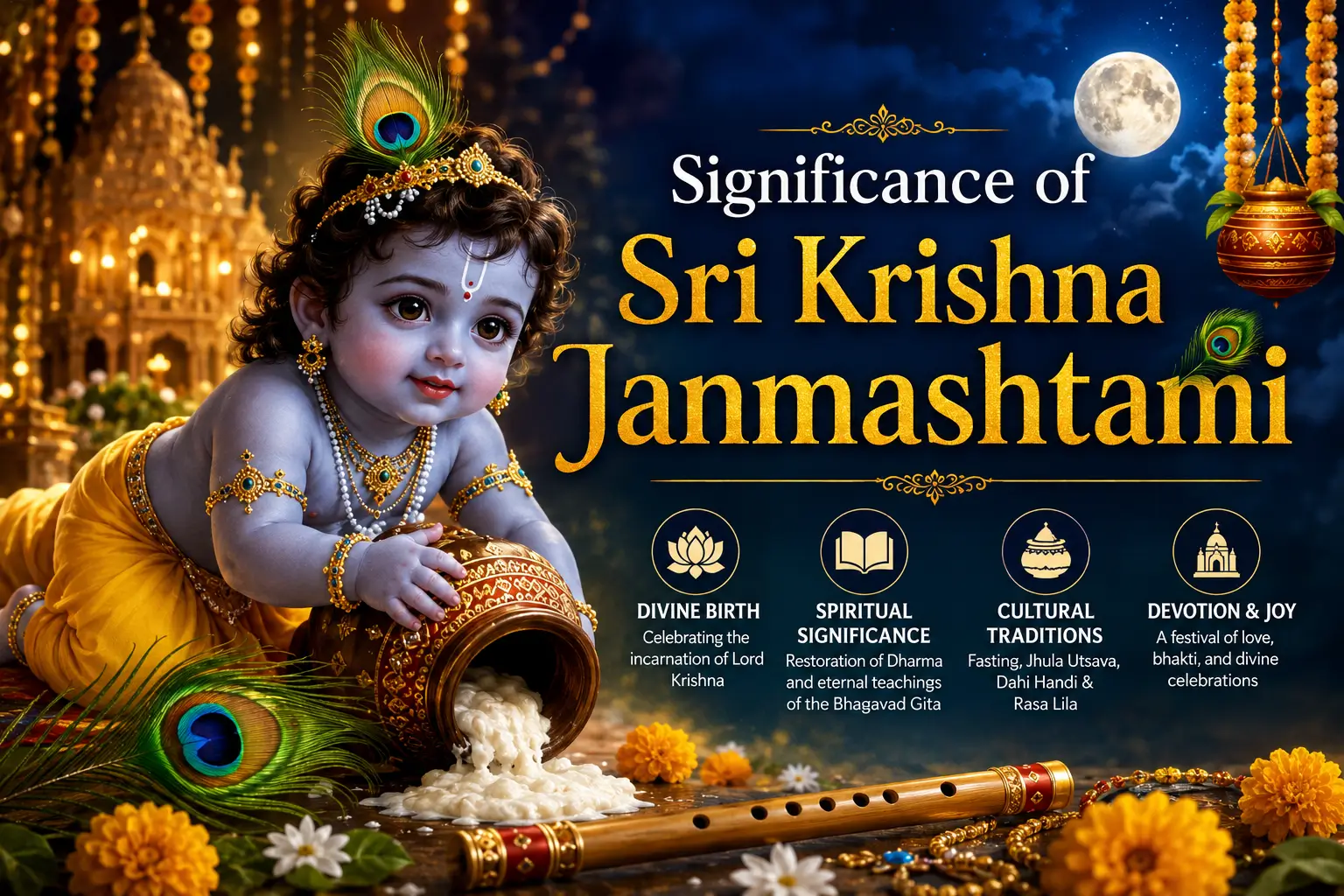
Sri Krishna Janmashtami, celebrated on the eighth day (Ashtami) of the dark fortnight in the month of Bhadrapada (August–September), marks the divine birth of Lord Krishna, the eighth avatar of Vishnu. The festival is observed with midnight vigils, fasting, devotional songs, and joyous cultural programs. The significance of Sri Krishna Janmashtami lies not only in its religious roots but also in its cultural and social impact, reminding devotees of Krishna’s eternal message of dharma, devotion, and joy.
As a festival expert, I’ve seen how families narrate Krishna’s childhood tales to children, temples organize elaborate tableaux, and communities unite in celebrations that blend spirituality with festivity.
Religious Significance
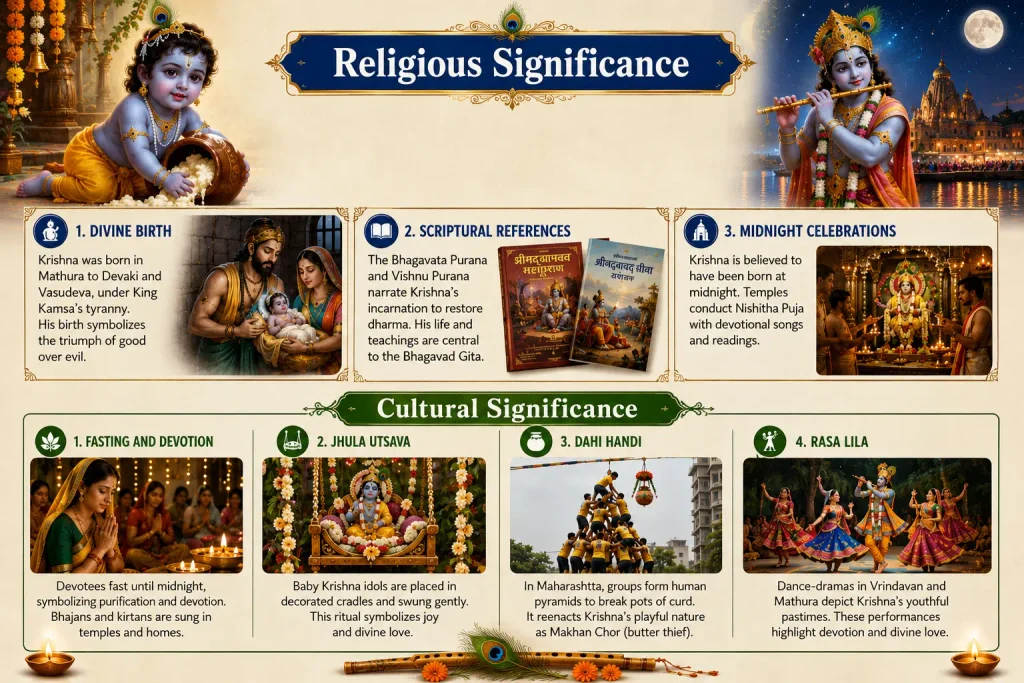
Divine Birth
- Krishna was born in Mathura to Devaki and Vasudeva, under King Kamsa’s tyranny.
- His birth symbolizes the triumph of good over evil.
Scriptural References
- The Bhagavata Purana and Vishnu Purana narrate Krishna’s incarnation to restore dharma.
- His life and teachings are central to the Bhagavad Gita.
Midnight Celebrations
- Krishna is believed to have been born at midnight.
- Temples conduct Nishitha Puja with devotional songs and readings.
Cultural Significance
Fasting and Devotion
- Devotees fast until midnight, symbolizing purification and devotion.
- Bhajans and kirtans are sung in temples and homes.
Jhula Utsava
- Baby Krishna idols are placed in decorated cradles and swung gently.
- This ritual symbolizes joy and divine love.
Dahi Handi
- In Maharashtra, groups form human pyramids to break pots of curd.
- It reenacts Krishna’s playful nature as Makhan Chor (butter thief).
Rasa Lila
- Dance-dramas in Vrindavan and Mathura depict Krishna’s youthful pastimes.
- These performances highlight devotion and divine love.
Social Significance
- Unity: Celebrated across India and globally by ISKCON communities.
- Community Bonding: Dahi Handi and temple festivities bring people together.
- Cultural Pride: Reinforces India’s heritage through music, dance, and rituals.
Spiritual vs Cultural Significance
| Aspect | Spiritual Significance | Cultural Significance |
|---|---|---|
| Birth of Krishna | Avatar of Vishnu to restore dharma | Midnight vigils, temple rituals |
| Symbolism | Triumph of good over evil | Dahi Handi, Rasa Lila |
| Devotion | Fasting, chanting, scripture recitation | Community celebrations, sweets, music |
| Impact | Reinforces spiritual values | Strengthens social unity |
Frequently Asked Questions (FAQs)
Que 1: Why is Janmashtami celebrated at midnight?
Ans: Because Krishna is believed to have been born at midnight in Mathura.
Que 2: What is the importance of fasting on Janmashtami?
Ans: It symbolizes purification and devotion, culminating in midnight worship.
Ques 3: How is Janmashtami celebrated differently across India?
Ans: Mathura and Vrindavan focus on Rasa Lila, Maharashtra on Dahi Handi, and South India on Gokulashtami rituals.
Que 4: Is Janmashtami only a religious festival?
Ans: No, it is also cultural, with plays, dances, and community bonding activities.
Personal Insight as a Festival Expert
In my experience, Janmashtami is one of the most vibrant festivals in India. Families narrate Krishna’s childhood tales to children, temples organize elaborate tableaux, and communities unite in joyous celebrations. The festival’s significance lies not only in mythology but in its ability to inspire values of devotion, unity, and righteousness across generations.
Conclusion
The significance of Sri Krishna Janmashtami lies in its blend of spirituality, culture, and social unity. It commemorates Krishna’s divine birth, reminding devotees of the eternal triumph of dharma over adharma. From midnight vigils to Dahi Handi, Janmashtami is a living tradition that continues to inspire devotion, joy, and cultural pride.

I am Disha Sharma the founder and writer of Great Indian Festival with a passion for storytelling and a dedication to sharing knowledge, I create content that informs, inspires, and connects with readers. My writing reflects creativity, clarity, and a commitment to delivering valuable insights across topics that matter.
3 thoughts on “Significance of Sri Krishna Janmashtami — Spiritual & Cultural Dimensions”