|
Getting your Trinity Audio player ready...
|
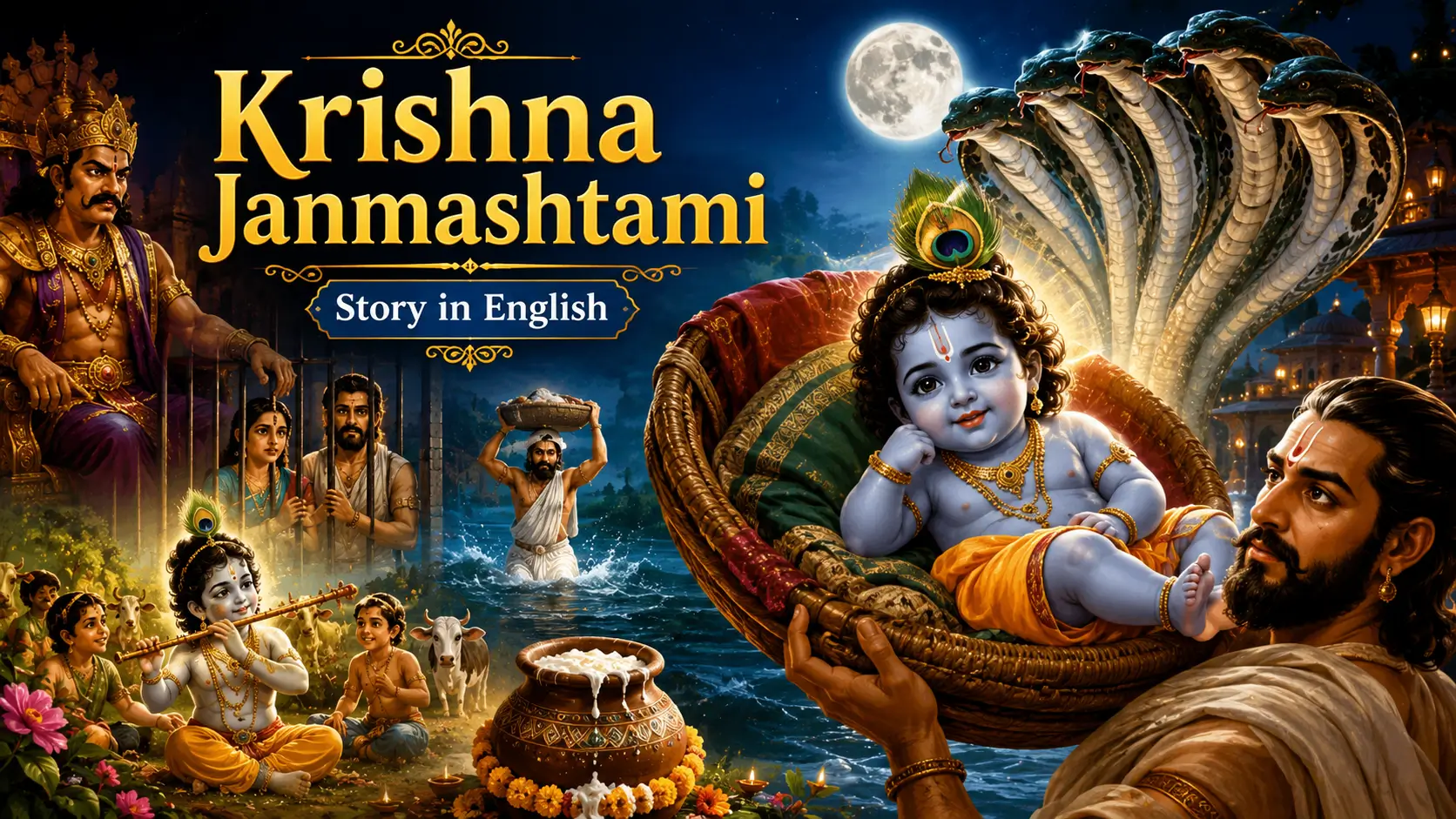
Krishna Janmashtami is one of the most celebrated festivals in India, marking the divine birth of Lord Krishna, the eighth incarnation of Lord Vishnu. Observed on the eighth day (Ashtami) of the dark fortnight in the month of Bhadrapada (August–September), the festival is filled with devotion, fasting, midnight prayers, and joyous cultural programs. The story of Krishna Janmashtami in English is not just a tale of mythology but a timeless narrative of faith, righteousness, and the triumph of good over evil.
As a festival expert, I’ve seen how families narrate this story to children, keeping alive the heritage of devotion and cultural pride across generations.
The Story of Krishna Janmashtami
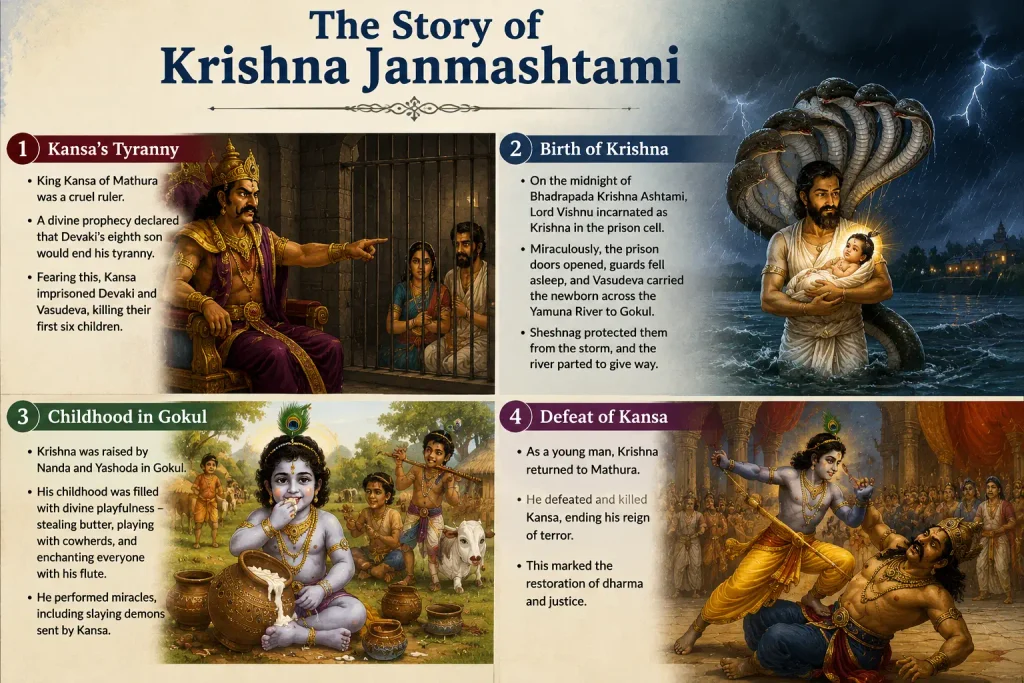
Kansa’s Tyranny
- King Kansa of Mathura was a cruel ruler.
- A divine prophecy declared that Devaki’s eighth son would end his tyranny.
- Fearing this, Kansa imprisoned Devaki and her husband Vasudeva, killing their first six children.
Birth of Krishna
- On the midnight of Bhadrapada Krishna Ashtami, Lord Vishnu incarnated as Krishna in the prison cell.
- Miraculously, the prison doors opened, guards fell asleep, and Vasudeva carried the newborn across the Yamuna River to Gokul.
- Sheshnag protected them from the storm, and the river parted to give way.
Childhood in Gokul
- Krishna was raised by Nanda and Yashoda in Gokul.
- His childhood was filled with divine playfulness — stealing butter, playing with cowherds, and enchanting everyone with his flute.
- He performed miracles, including slaying demons sent by Kansa.
Defeat of Kansa
- As a young man, Krishna returned to Mathura.
- He defeated and killed Kansa, ending his reign of terror.
- This marked the restoration of dharma and justice.
Religious Significance
- Restoration of Dharma: Krishna’s birth symbolizes the triumph of righteousness.
- Spiritual Message: His life and teachings, especially the Bhagavad Gita, guide humanity.
- Midnight Birth: Symbolizes light emerging from darkness.
Cultural Significance
- Mathura and Vrindavan: Famous for Rasa Lila and devotional plays.
- Maharashtra: Celebrated with Dahi Handi, reenacting Krishna’s butter-stealing adventures.
- South India: Known as Gokulashtami, with special pujas and offerings.
Also Read: Significance of Sri Krishna Janmashtami — Spiritual & Cultural Dimensions
Religious vs Cultural Importance
| Aspect | Religious Importance | Cultural Importance |
|---|---|---|
| Birth | Divine incarnation of Vishnu | Midnight vigils, temple rituals |
| Symbolism | Triumph of good over evil | Dahi Handi, Rasa Lila |
| Devotion | Fasting, chanting, scripture recitation | Community celebrations, sweets, music |
| Impact | Reinforces spiritual values | Strengthens social unity |
Frequently Asked Questions (FAQs)
Que 1: Why is Krishna Janmashtami celebrated at midnight?
Ans: Because Krishna is believed to have been born at midnight in Mathura.
Que 2: What is the importance of fasting on Janmashtami?
Ans: It symbolizes purification and devotion, culminating in midnight worship.
Que 3: How is Janmashtami celebrated differently across India?
Ans: Mathura and Vrindavan focus on Rasa Lila, Maharashtra on Dahi Handi, and South India on Gokulashtami rituals.
Que 4: Is Janmashtami only a religious festival?
Ans: No, it is also cultural, with plays, dances, and community bonding activities.
Personal Insight as a Festival Expert
In my experience, Janmashtami is one of the most vibrant festivals in India. Families narrate Krishna’s childhood tales to children, temples organize elaborate tableaux, and communities unite in joyous celebrations. The festival’s significance lies not only in mythology but in its ability to inspire values of devotion, unity, and righteousness across generations.
Conclusion
The Krishna Janmashtami story in English narrates the divine birth of Lord Krishna, his childhood miracles, and his victory over Kansa. It is a tale of faith, humility, and devotion that has shaped India’s cultural identity. Janmashtami is not just a festival but a living tradition that continues to inspire people with the eternal message of dharma, unity, and joy.

I am Disha Sharma the founder and writer of Great Indian Festival with a passion for storytelling and a dedication to sharing knowledge, I create content that informs, inspires, and connects with readers. My writing reflects creativity, clarity, and a commitment to delivering valuable insights across topics that matter.
1 thought on “Krishna Janmashtami Story in English — Birth, Legends & Significance”