|
Getting your Trinity Audio player ready...
|
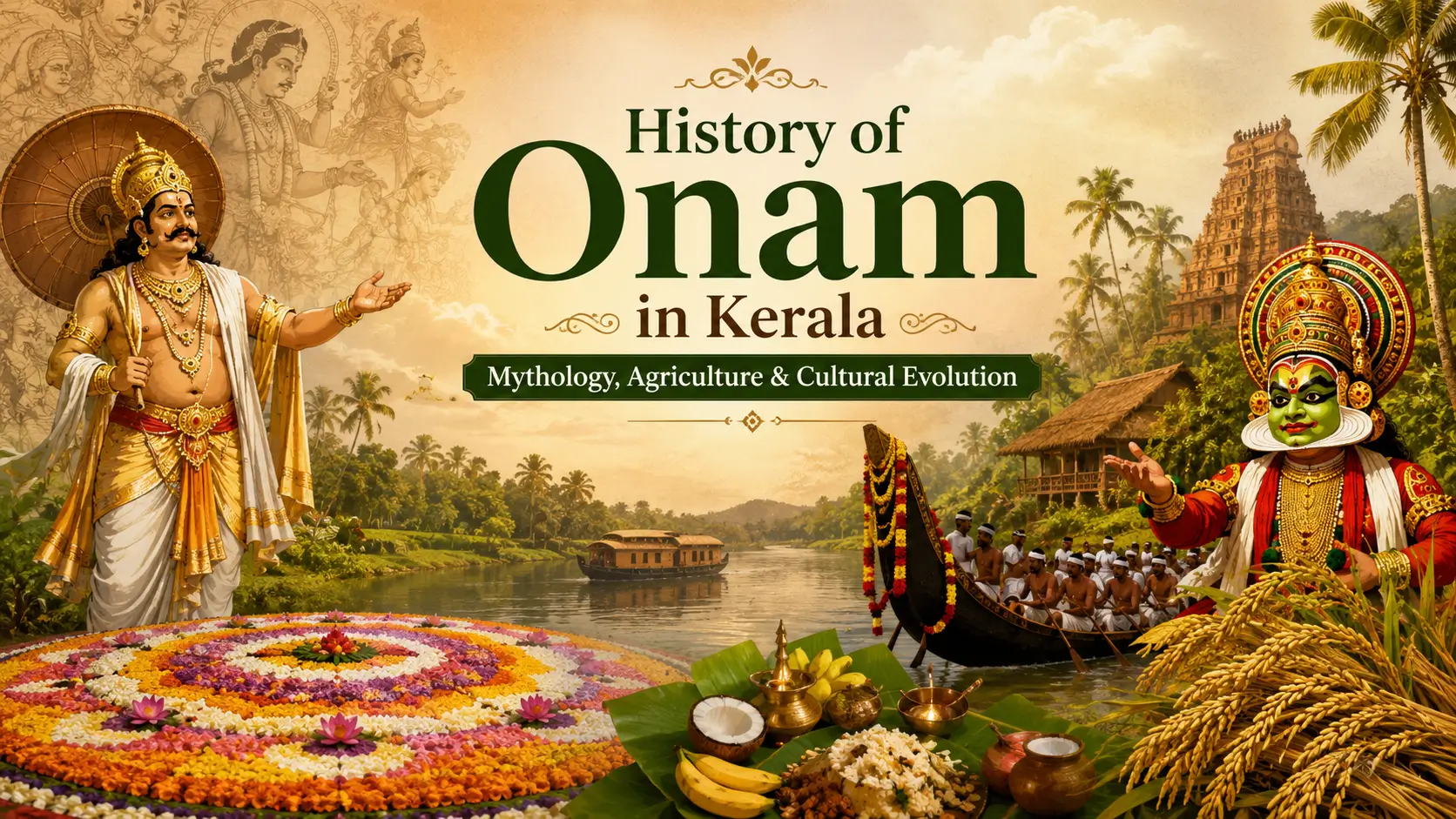
Onam, Kerala’s grand harvest festival, is celebrated annually in the Malayalam month of Chingam (August–September). It is not only a cultural celebration but also a commemoration of the legendary King Mahabali, whose reign is remembered as a golden age of prosperity and equality. The history of Onam in Kerala reveals how mythology, agrarian traditions, and state identity merged to create one of India’s most vibrant festivals.
Mythological Origins
King Mahabali
- Mahabali, a benevolent Asura king, ruled Kerala with justice and generosity.
- His growing influence worried the Devas, who sought Lord Vishnu’s intervention.
- Vishnu incarnated as Vamana, a dwarf Brahmin, and asked Mahabali for three paces of land.
- Expanding to cosmic size, Vamana covered heaven and earth in two steps; Mahabali offered his head for the third.
- Vishnu granted Mahabali’s wish to visit his people once a year — celebrated as Onam.
Krishna and Kaliya Naag
In some traditions, Onam is also linked to Krishna’s victory over Kaliya Naag, symbolizing triumph of good over evil.
Historical References
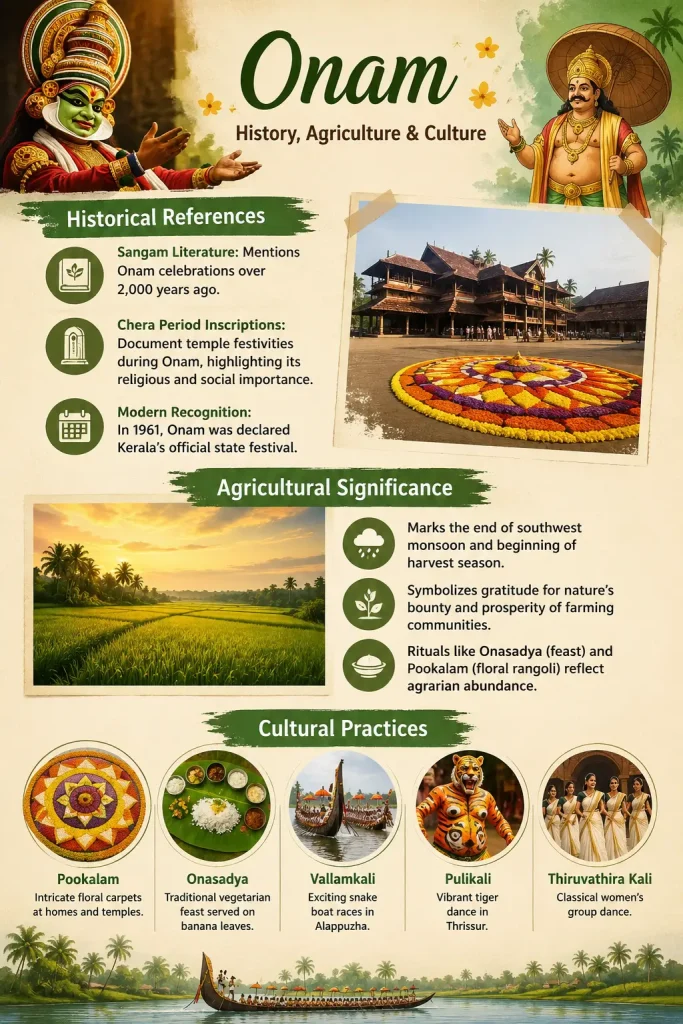
- Sangam Literature: Mentions Onam celebrations over 2,000 years ago.
- Chera Period Inscriptions: Document temple festivities during Onam, highlighting its religious and social importance.
- Modern Recognition: In 1961, Onam was declared Kerala’s official state festival.
Agricultural Significance
- Marks the end of southwest monsoon and beginning of harvest season.
- Symbolizes gratitude for nature’s bounty and prosperity of farming communities.
- Rituals like Onasadya (feast) and Pookalam (floral rangoli) reflect agrarian abundance.
Cultural Practices
- Pookalam: Intricate floral carpets at homes and temples.
- Onasadya: Traditional vegetarian feast served on banana leaves.
- Vallamkali: Snake boat races in Alappuzha.
- Pulikali: Tiger dance in Thrissur.
- Thiruvathira Kali: Classical women’s group dance.
Myth vs History
| Aspect | Mythological Origin | Historical Evidence |
|---|---|---|
| King Mahabali | Vamana avatar story | Sangam literature mentions |
| Vishnu’s Role | Cosmic three steps | Temple inscriptions in Chera period |
| Annual Return | Mahabali’s boon | Declared state festival in 1961 |
Also Read: Story Behind Onam in Malayalam — King Mahabali & Vamana
FAQs
Ques1: Who started Onam in Kerala?
Ans: It originates from the legend of King Mahabali and Lord Vishnu’s Vamana avatar.
Q2: How old is Onam?
Ans: Over 2,000 years, with references in Sangam literature.
Q3: Why is Onam important agriculturally?
Ans: It marks the harvest season and gratitude for nature’s bounty.
Q4: Is Onam only a Hindu festival?
Ans: Though rooted in Hindu mythology, it is celebrated across communities as Kerala’s cultural identity.
Personal Insight as a Festival Expert
Onam’s history is not confined to mythology; it is Kerala’s living heritage. I have seen how families narrate Mahabali’s story to children, while communities unite in boat races and feasts. The festival’s endurance shows how myth, agriculture, and culture intertwine to preserve Kerala’s identity.
Conclusion
The history of Onam in Kerala is a tapestry of mythological legends, agrarian traditions, and cultural evolution. From Mahabali’s golden reign to Sangam literature and modern state recognition, Onam has grown into a festival that embodies prosperity, unity, and Kerala’s timeless heritage.

I am Disha Sharma the founder and writer of Great Indian Festival with a passion for storytelling and a dedication to sharing knowledge, I create content that informs, inspires, and connects with readers. My writing reflects creativity, clarity, and a commitment to delivering valuable insights across topics that matter.
1 thought on “History of Onam in Kerala — Mythology, Agriculture & Cultural Evolution”